Ch. 8 - Integration Techniques
Briggs - Calculus: Early Transcendentals 3rd Edition
Briggs3rd EditionCalculus: Early TranscendentalsISBN: 9780136847243Not the one you use?Change textbook
Chapter 8, Problem 8.4.83

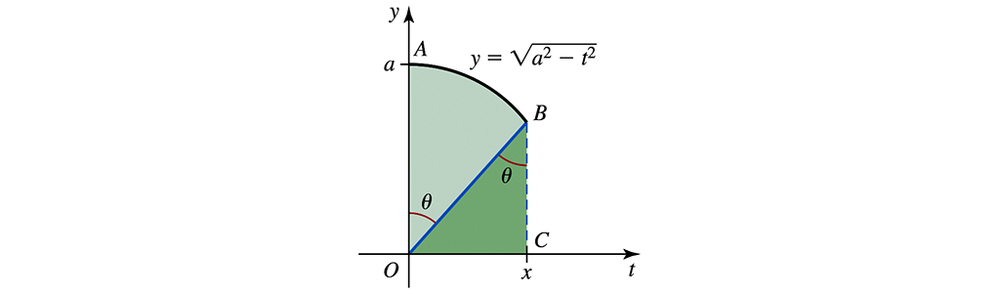
Visual proof Let F(x)=∫₀ˣ √(a²−t²) dt. The figure shows that F(x)= area of sector OAB+ area of triangle OBC.
a. Use the figure to prove that
F(x) = (a² sin ⁻¹(x/a))/2 + x√(a²−x²)/2
b. Conclude that ∫ √(a²−x²) dx = (a² sin ⁻¹(x/a))/2 + x√(a²−x²)/2 + C.
Graph showing area under curve y = √(a²−t²) as sum of sector OAB and triangle OBC with angle θ.

Verified step by step guidance
1
Step 1: Recognize that the function \(F(x) = \int_0^x \sqrt{a^2 - t^2} \, dt\) represents the area under the curve \(y = \sqrt{a^2 - t^2}\) from \(t=0\) to \(t=x\). The figure shows this area as the sum of two parts: the area of sector \(OAB\) and the area of triangle \(OBC\).
Step 2: Identify the angle \(\theta\) in the figure, where \(\theta = \sin^{-1}(x/a)\). This comes from the right triangle \(OBC\) where \(OC = x\) and \(OB = a\), so \(\sin \theta = \frac{x}{a}\).
Step 3: Calculate the area of sector \(OAB\). Since \(OAB\) is a sector of a circle with radius \(a\) and central angle \(\theta\), its area is given by \(\frac{1}{2} a^2 \theta = \frac{1}{2} a^2 \sin^{-1}(x/a)\).
Step 4: Calculate the area of triangle \(OBC\). The base \(OC\) is \(x\) and the height \(BC\) is \(\sqrt{a^2 - x^2}\) (from the Pythagorean theorem). Therefore, the area of triangle \(OBC\) is \(\frac{1}{2} \times x \times \sqrt{a^2 - x^2}\).
Step 5: Add the two areas to express \(F(x)\) as the sum of the sector and triangle areas: \(F(x) = \frac{1}{2} a^2 \sin^{-1}(x/a) + \frac{1}{2} x \sqrt{a^2 - x^2}\). This completes the proof for part (a). For part (b), since \(F'(x) = \sqrt{a^2 - x^2}\), the integral \(\int \sqrt{a^2 - x^2} \, dx\) equals \(F(x) + C\), giving the formula \(\int \sqrt{a^2 - x^2} \, dx = \frac{1}{2} a^2 \sin^{-1}(x/a) + \frac{1}{2} x \sqrt{a^2 - x^2} + C\).

Verified video answer for a similar problem:

This video solution was recommended by our tutors as helpful for the problem above.
Video duration:
4m
Was this helpful?

Key Concepts

Here are the essential concepts you must grasp in order to answer the question correctly.

Definite Integral as Area Under a Curve

The definite integral of a function from 0 to x represents the area under the curve between these limits. In this problem, F(x) = ∫₀ˣ √(a²−t²) dt corresponds to the area under the semicircle y = √(a²−t²), which can be geometrically interpreted as the sum of areas of simpler shapes.
Recommended video:
05:43
Definition of the Definite Integral

Area of a Circular Sector

A sector of a circle is a portion bounded by two radii and the arc between them. Its area is given by (1/2)r²θ, where r is the radius and θ is the central angle in radians. Here, the sector OAB with radius a and angle θ = sin⁻¹(x/a) helps express part of the integral's area.
Recommended video:
07:45
Area of Polar Regions

Area of a Triangle Using Trigonometry

The area of a triangle can be found using (1/2) base × height or (1/2)ab sin C for two sides a, b and included angle C. In this problem, triangle OBC's area is computed using the base x and height √(a²−x²), which complements the sector area to represent the integral.
Recommended video:
6:04
Introduction to Trigonometric Functions
Related Practice
Textbook Question

76–83. Preliminary steps The following integrals require a preliminary step such as a change of variables before using the method of partial fractions. Evaluate these integrals.

76. ∫ [cosθ / (sin³θ - 4sinθ)] dθ

1
views

Textbook Question

{Use of Tech} Using the integral of sec³u By reduction formula 4 in Section 8.3,

∫sec³u du = 1/2 (sec u tan u + ln |sec u + tan u|) + C


Graph the following functions and find the area under the curve on the given interval.

f(x) = (9 - x²) ⁻², [0, 3/2]

1
views
Textbook Question

102–106. Laplace transforms A powerful tool in solving problems in engineering and physics is the Laplace transform. Given a function f(t), the Laplace transform is a new function F(s) defined by F(s) = ∫[0 to ∞] e^(-st) f(t) dt, where we assume s is a positive real number. For example, to find the Laplace transform of f(t) = e^(-t), the following improper integral is evaluated using integration by parts:

F(s) = ∫[0 to ∞] e^(-st) e^(-t) dt = ∫[0 to ∞] e^(-(s+1)t) dt = 1/(s+1).

Verify the following Laplace transforms, where a is a real number.

106. f(t) = cos(at) → F(s) = s/(s² + a²)

1
views
Textbook Question

64. (Use of Tech) Normal distribution of movie lengths

A study revealed that the lengths of U.S. movies are normally distributed with a mean of 110 minutes and a standard deviation of 22 minutes. This means that the fraction of movies with lengths between a and b minutes (with a < b) is given by the integral:

(1/(22√(2π))) ∫[a to b] e^(-((x-110)/22)²/2) dx.

What percentage of U.S. movies are between 1 hr and 1.5 hr long (60-90 min)?

Textbook Question

70. Different methods Let I=∫(x+2)/(x+4)dx.

b. Evaluate I without performing long division on the integrand.

Textbook Question

7–58. Improper integrals Evaluate the following integrals or state that they diverge.

42. ∫ (from 3 to 4) 1/(x-3)³ᐟ² dx

1
views