Ch. 8 - Integration Techniques
Briggs - Calculus: Early Transcendentals 3rd Edition
Briggs3rd EditionCalculus: Early TranscendentalsISBN: 9780136847243Not the one you use?Change textbook
Chapter 8, Problem 8.7.86b

Let L(c) be the length of the parabola f(x) = x² from x = 0 to x = c, where c ≥ 0 is a constant.
b. Is L concave up or concave down on [0, ∞)?

Verified step by step guidance
1
Step 1: Recall the formula for the arc length of a curve y = f(x) from x = a to x = b: \( L = \int_a^b \sqrt{1 + \left( \frac{dy}{dx} \right)^2} dx \). Here, \( f(x) = x^2 \), so \( \frac{dy}{dx} = 2x \).
Step 2: Substitute \( \frac{dy}{dx} = 2x \) into the arc length formula. This gives \( L(c) = \int_0^c \sqrt{1 + (2x)^2} dx \), which simplifies to \( L(c) = \int_0^c \sqrt{1 + 4x^2} dx \).
Step 3: To determine whether \( L(c) \) is concave up or concave down, compute the first derivative \( L'(c) \) and the second derivative \( L''(c) \). Start by differentiating \( L(c) \) with respect to \( c \). Using the Fundamental Theorem of Calculus, \( L'(c) = \sqrt{1 + 4c^2} \).
Step 4: Differentiate \( L'(c) = \sqrt{1 + 4c^2} \) to find \( L''(c) \). Use the chain rule: \( L''(c) = \frac{d}{dc} \sqrt{1 + 4c^2} = \frac{1}{2\sqrt{1 + 4c^2}} \cdot 8c \), which simplifies to \( L''(c) = \frac{4c}{\sqrt{1 + 4c^2}} \).
Step 5: Analyze the sign of \( L''(c) \) on \([0, \infty)\). Since \( c \geq 0 \) and \( \sqrt{1 + 4c^2} > 0 \), \( L''(c) > 0 \) for all \( c \geq 0 \). Therefore, \( L(c) \) is concave up on \([0, \infty)\).

Verified video answer for a similar problem:

This video solution was recommended by our tutors as helpful for the problem above.
Video duration:
4m
Was this helpful?

Key Concepts

Here are the essential concepts you must grasp in order to answer the question correctly.

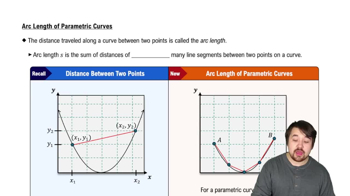
Arc Length of a Curve

The arc length of a curve defined by a function f(x) from x = a to x = b is calculated using the formula L = ∫[a to b] √(1 + (f'(x))²) dx. For the parabola f(x) = x², we first need to find its derivative f'(x) = 2x, which will be used in the arc length formula to determine L(c) from 0 to c.
Recommended video:
06:29
Arc Length of Parametric Curves

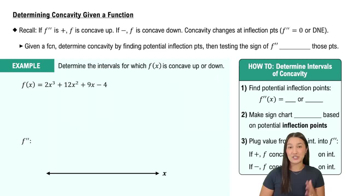
Concavity

Concavity refers to the direction in which a curve bends. A function is concave up on an interval if its second derivative is positive, indicating that the slope of the tangent line is increasing. Conversely, it is concave down if the second derivative is negative. Understanding concavity helps in analyzing the behavior of the length function L(c) as c varies.
Recommended video:
05:59
Determining Concavity Given a Function

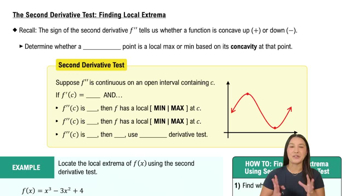
Second Derivative Test

The second derivative test is a method used to determine the concavity of a function. By computing the second derivative of L(c), we can assess whether it is positive or negative over the interval [0, ∞). This test is crucial for answering whether L(c) is concave up or down, providing insights into the nature of the length of the parabola as c increases.
Recommended video:
06:02
The Second Derivative Test: Finding Local Extrema