
Ch. 8 - Integration Techniques
Briggs - Calculus: Early Transcendentals 3rd Edition
Briggs3rd EditionCalculus: Early TranscendentalsISBN: 9780136847243Not the one you use?Change textbook
Chapter 8, Problem 8.2.17

9–40. Integration by parts Evaluate the following integrals using integration by parts.
17. ∫ x · 3x dx

Verified step by step guidance
1
Identify the integral to solve: \(\int x \cdot 3^x \, dx\).
Recall the integration by parts formula: \(\int u \, dv = uv - \int v \, du\).
Choose \(u\) and \(dv\) wisely. Let \(u = x\) (which simplifies when differentiated) and \(dv = 3^x \, dx\) (which can be integrated).
Compute \(du\) by differentiating \(u\): \(du = dx\). Compute \(v\) by integrating \(dv\): \(v = \int 3^x \, dx\); remember that \(\int a^x \, dx = \frac{a^x}{\ln(a)} + C\) for \(a > 0\), \(a \neq 1\).
Apply the integration by parts formula: \(\int x \cdot 3^x \, dx = u v - \int v \, du = x \cdot v - \int v \, dx\). Then simplify and evaluate the remaining integral.

Verified video answer for a similar problem:

This video solution was recommended by our tutors as helpful for the problem above.
Video duration:
3m
Was this helpful?

Key Concepts

Here are the essential concepts you must grasp in order to answer the question correctly.

Integration by Parts

Integration by parts is a technique derived from the product rule of differentiation. It transforms the integral of a product of functions into simpler integrals using the formula ∫u dv = uv - ∫v du. Choosing u and dv wisely is crucial to simplify the problem.
Recommended video:
06:18
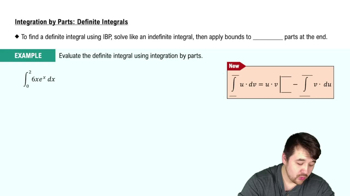
Integration by Parts for Definite Integrals

Choosing u and dv

In integration by parts, selecting u (a function to differentiate) and dv (a function to integrate) affects the ease of solving the integral. Typically, u is chosen as a function that simplifies when differentiated, and dv is chosen as a function that is easy to integrate.
Recommended video:
07:51
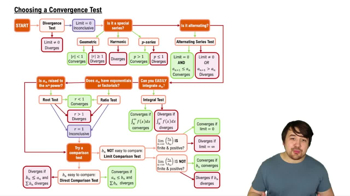
Choosing a Convergence Test

Integrating Exponential Functions

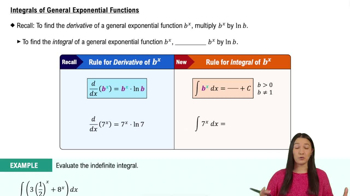
When integrating expressions involving exponential functions like 3^x, recall that the integral of a^x is (a^x)/(ln a) + C for a > 0, a ≠ 1. This knowledge helps in computing dv or v when the exponential function is part of the integral.
Recommended video:
05:11
Integrals of General Exponential Functions
Related Practice
Textbook Question

37-40. {Use of Tech} Temperature data

Howdy temperature data for Boulder, Colorado; San Francisco, California; Nantucket, Massachusetts; and Duluth, Minnesota, over a 12-hr period on the same day of January are shown in the figure.

Assume these data are taken from a continuous temperature function T(t). The average temperature (in °F) over the 12-hr period is:

T_avg = (1/12) × ∫(0 to 12) T(t) dt

38. Find an accurate approximation to the average temperature over the 12-hr period for San Francisco. State your method.

Textbook Question

102–106. Laplace transforms A powerful tool in solving problems in engineering and physics is the Laplace transform. Given a function f(t), the Laplace transform is a new function F(s) defined by F(s) = ∫[0 to ∞] e^(-st) f(t) dt, where we assume s is a positive real number. For example, to find the Laplace transform of f(t) = e^(-t), the following improper integral is evaluated using integration by parts:

F(s) = ∫[0 to ∞] e^(-st) e^(-t) dt = ∫[0 to ∞] e^(-(s+1)t) dt = 1/(s+1).

Verify the following Laplace transforms, where a is a real number.

104. f(t) = t → F(s) = 1/s²

1
views
Textbook Question

69. Different substitutions

b. Evaluate ∫(tan x sec² x) dx using the substitution u=secx.

Textbook Question

7–40. Table look-up integrals Use a table of integrals to evaluate the following indefinite integrals. Some of the integrals require preliminary work, such as completing the square or changing variables, before they can be found in a table.

28. ∫ ln² x dx

Textbook Question

9–40. Integration by parts Evaluate the following integrals using integration by parts.

32. ∫ from 0 to 1 x² 2ˣ dx

1
views
Textbook Question

49–52. {Use of Tech} Simpson’s Rule

Apply Simpson’s Rule to the following integrals. It is easiest to obtain the Simpson’s Rule approximations from the Trapezoid Rule approximations, as in Example 8. Make a table similar to Table 8.8 showing the approximations and errors for n = 4, 8, 16, and 32. The exact values of the integrals are given for computing the error.

51. ∫(from 0 to π) e⁻ᵗ sin(t) dt = ½(e⁻ᵖⁱ + 1)