Ch. 8 - Integration Techniques
Briggs - Calculus: Early Transcendentals 3rd Edition
Briggs3rd EditionCalculus: Early TranscendentalsISBN: 9780136847243Not the one you use?Change textbook
Chapter 8, Problem 8.2.14

9–40. Integration by parts Evaluate the following integrals using integration by parts.
14. ∫ s · e⁻²ˢ ds

Verified step by step guidance
1
Identify the parts of the integral for integration by parts. Let \(u = s\) and \(dv = e^{-2s} \, ds\).
Compute \(du\) by differentiating \(u\): \(du = ds\).
Compute \(v\) by integrating \(dv\): \(v = \int e^{-2s} \, ds\). Recall that \(\int e^{ax} \, dx = \frac{1}{a} e^{ax} + C\), so here \(v = -\frac{1}{2} e^{-2s}\).
Apply the integration by parts formula: \(\int u \, dv = uv - \int v \, du\). Substitute the expressions for \(u\), \(v\), \(du\) to get \(s \cdot \left(-\frac{1}{2} e^{-2s}\right) - \int \left(-\frac{1}{2} e^{-2s}\right) \, ds\).
Simplify the integral and evaluate \(\int e^{-2s} \, ds\) again to complete the solution.

Verified video answer for a similar problem:

This video solution was recommended by our tutors as helpful for the problem above.
Video duration:
3m
Was this helpful?

Key Concepts

Here are the essential concepts you must grasp in order to answer the question correctly.

Integration by Parts

Integration by parts is a technique derived from the product rule of differentiation. It transforms the integral of a product of functions into simpler integrals using the formula ∫u dv = uv - ∫v du. Choosing u and dv wisely simplifies the integration process.
Recommended video:
06:18
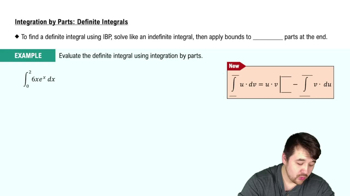
Integration by Parts for Definite Integrals

Choosing u and dv

Selecting which part of the integrand to assign as u and which as dv is crucial. Typically, u is chosen as a function that simplifies when differentiated, and dv as a function that is easy to integrate. This choice affects the ease of solving the integral.
Recommended video:
07:51
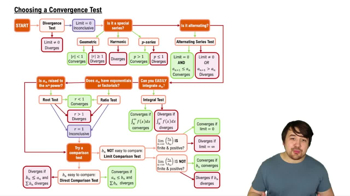
Choosing a Convergence Test

Integration of Exponential Functions

Integrating exponential functions like e^(-2s) involves recognizing the integral formula ∫e^(as) ds = (1/a)e^(as) + C. Understanding how to handle constants in the exponent is essential for correctly computing the integral after applying integration by parts.
Recommended video:
05:11
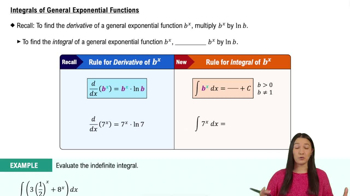
Integrals of General Exponential Functions