Ch. 8 - Integration Techniques
Briggs - Calculus: Early Transcendentals 3rd Edition
Briggs3rd EditionCalculus: Early TranscendentalsISBN: 9780136847243Not the one you use?Change textbook
Chapter 8, Problem 8.8.9

9. If the Trapezoid Rule is used on the interval [-1, 9] with n = 5 subintervals, at what x-coordinates is the integrand evaluated?

Verified step by step guidance
1
Step 1: Understand the Trapezoid Rule. The Trapezoid Rule approximates the integral of a function by dividing the interval into 'n' subintervals and calculating the area of trapezoids formed under the curve. The x-coordinates where the integrand is evaluated are the endpoints of these subintervals.
Step 2: Identify the interval and the number of subintervals. The interval is [-1, 9], and the number of subintervals is n = 5.
Step 3: Calculate the width of each subinterval (Δx). The formula for Δx is Δx = (b - a) / n, where 'a' is the starting point of the interval, 'b' is the endpoint, and 'n' is the number of subintervals. Substitute a = -1, b = 9, and n = 5 into the formula.
Step 4: Determine the x-coordinates. Start at the left endpoint (x = -1) and add Δx successively to find the x-coordinates of the subinterval endpoints. These will be x₀, x₁, x₂, x₃, x₄, and x₅.
Step 5: Write the x-coordinates explicitly. The x-coordinates are the points where the integrand is evaluated, and they are evenly spaced based on the calculated Δx.

Verified video answer for a similar problem:

This video solution was recommended by our tutors as helpful for the problem above.
Video duration:
3m
Was this helpful?

Key Concepts

Here are the essential concepts you must grasp in order to answer the question correctly.

Trapezoid Rule

The Trapezoid Rule is a numerical method for approximating the definite integral of a function. It works by dividing the area under the curve into trapezoids rather than rectangles, providing a more accurate estimate. The formula involves calculating the average of the function values at the endpoints of each subinterval and multiplying by the width of the subinterval.
Recommended video:

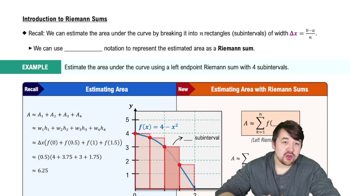
Subintervals

In numerical integration, a subinterval is a smaller segment of the overall interval over which the integral is being calculated. The number of subintervals, denoted as 'n', determines how finely the interval is divided, affecting the accuracy of the approximation. More subintervals generally lead to a better approximation of the integral.
Recommended video:
06:11
Introduction to Riemann Sums

Evaluation Points

Evaluation points are the specific x-coordinates at which the function is calculated to apply the Trapezoid Rule. For an interval divided into 'n' subintervals, these points are determined by the endpoints and the width of each subinterval. In this case, the evaluation points will be the endpoints of the interval and the points that divide it into equal segments.
Recommended video:
04:50
Critical Points