

Ch. 8 - Integration Techniques
Briggs - Calculus: Early Transcendentals 3rd Edition
Briggs3rd EditionCalculus: Early TranscendentalsISBN: 9780136847243Not the one you use?Change textbook
Chapter 8, Problem 8.6.87

87. Surface area Find the area of the surface generated when the curve f(x) = sin x on [0, π/2] is revolved about the x-axis.

Verified step by step guidance
1
Step 1: Recall the formula for the surface area of a curve revolved about the x-axis. The formula is: A = 2π ∫[a,b] f(x) √(1 + (f'(x))²) dx, where f(x) is the function being revolved, and f'(x) is its derivative.
Step 2: Identify the function and interval from the problem. Here, f(x) = sin(x) and the interval is [0, π/2].
Step 3: Compute the derivative of f(x). The derivative of f(x) = sin(x) is f'(x) = cos(x).
Step 4: Substitute f(x) = sin(x) and f'(x) = cos(x) into the formula. The integral becomes: A = 2π ∫[0,π/2] sin(x) √(1 + cos²(x)) dx.
Step 5: Set up the integral for evaluation. You now need to evaluate the integral ∫[0,π/2] sin(x) √(1 + cos²(x)) dx, which may require substitution or numerical methods depending on the complexity.

Verified video answer for a similar problem:

This video solution was recommended by our tutors as helpful for the problem above.
Video duration:
6m
Was this helpful?

Key Concepts

Here are the essential concepts you must grasp in order to answer the question correctly.

Surface Area of Revolution

The surface area of a solid of revolution is calculated using the formula A = 2π ∫[a to b] f(x) √(1 + (f'(x))^2) dx, where f(x) is the function being revolved, and [a, b] is the interval of revolution. This formula accounts for the curve's length and the circular cross-sections formed by the revolution.
Recommended video:
09:07
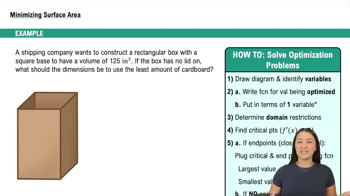
Example 1: Minimizing Surface Area

Definite Integral

A definite integral represents the accumulation of quantities, such as area under a curve, over a specific interval [a, b]. It is denoted as ∫[a to b] f(x) dx and provides a numerical value that corresponds to the total area between the curve f(x) and the x-axis from x = a to x = b.
Recommended video:
05:43
Definition of the Definite Integral

Derivative and its Role in Surface Area

The derivative f'(x) of a function f(x) indicates the slope of the tangent line at any point on the curve. In the context of surface area, the derivative is crucial for determining the rate of change of the function, which is used in the formula to calculate the surface area of revolution, specifically in the term √(1 + (f'(x))^2).
Recommended video:
09:07
Example 1: Minimizing Surface Area