
Textbook Question
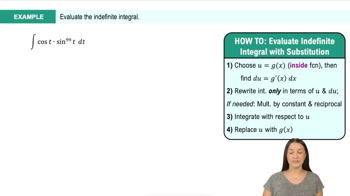
7. How would you evaluate ∫ tan¹⁰x sec²x dx?

 Verified step by step guidance
 03:24
03:24
 04:56
04:56 05:43
05:437. How would you evaluate ∫ tan¹⁰x sec²x dx?
7–84. Evaluate the following integrals.
16. ∫ [1 / (x⁴ – 1)] dx
95–98. {Use of Tech} Numerical methods Use numerical methods or a calculator to approximate the following integrals as closely as possible. The exact value of each integral is given.
98. ∫(from 0 to 1) (ln x)/(1+x) dx = -π²/12
7–40. Table look-up integrals Use a table of integrals to evaluate the following indefinite integrals. Some of the integrals require preliminary work, such as completing the square or changing variables, before they can be found in a table.
31. ∫ √(x² - 8x) dx, x > 8
63. (Use of Tech) Normal distribution of heights
The heights of U.S. men are normally distributed with a mean of 69 in and a standard deviation of 3 in. This means that the fraction of men with a height between a and b (with a < b) inches is given by the integral
(1/(3√(2π))) ∫ₐᵇ e^(-((x-69)/3)²/2) dx.
What percentage of American men are between 66 and 72 inches tall? Use the method of your choice, and experiment with the number of subintervals until you obtain successive approximations that differ by less than 10⁻³.
7–84. Evaluate the following integrals.
33. ∫ [eˣ / (a² + e²ˣ)] dx, where a ≠ 0