Ch. 8 - Integration Techniques
Briggs - Calculus: Early Transcendentals 3rd Edition
Briggs3rd EditionCalculus: Early TranscendentalsISBN: 9780136847243Not the one you use?Change textbook
Chapter 8, Problem 8.2.82e

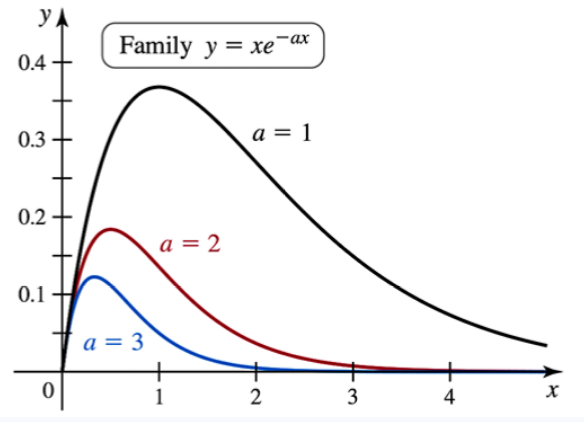
82. A family of exponentials The curves y = x * e^(-a * x) are shown in the figure for a = 1, 2, and 3.


Graph of y = x * e^(-a * x) showing curves for a = 1, 2, and 3, illustrating a family of exponential decay functions.


e. Does this pattern continue? Is it true that A(1, ln b) = a² * A(a, (ln b)/a)?

Verified step by step guidance
1
First, understand the function given: \(y = x e^{-a x}\), where \(a\) is a parameter that changes the shape of the curve. The graph shows this function for \(a = 1, 2, 3\).
Next, identify what \(A(a, b)\) represents in the problem. Typically, \(A(a, b)\) might denote the value of the function or an area related to the function at specific points. Here, it likely means the value of the function \(y = x e^{-a x}\) evaluated at \(x = b\) for a given \(a\), so \(A(a, b) = b e^{-a b}\).
To check the given relation \(A(1, \ln b) = a^2 \cdot A(a, \frac{\ln b}{a})\), substitute the definitions: - Compute \(A(1, \ln b) = (\ln b) e^{-1 \cdot \ln b}\). - Compute \(A(a, \frac{\ln b}{a}) = \left(\frac{\ln b}{a}\right) e^{-a \cdot \frac{\ln b}{a}}\).
Simplify the exponentials using the property \(e^{\ln x} = x\) and \(e^{-\ln x} = \frac{1}{x}\): - \(e^{-\ln b} = \frac{1}{b}\), - \(e^{-a \cdot \frac{\ln b}{a}} = e^{-\ln b} = \frac{1}{b}\).
After simplification, compare both sides of the equation: - Left side: \(A(1, \ln b) = (\ln b) \cdot \frac{1}{b} = \frac{\ln b}{b}\), - Right side: \(a^2 \cdot \left( \frac{\ln b}{a} \cdot \frac{1}{b} \right) = a^2 \cdot \frac{\ln b}{a b} = a \cdot \frac{\ln b}{b}\). Since the left side is \(\frac{\ln b}{b}\) and the right side is \(a \cdot \frac{\ln b}{b}\), the equality holds only if \(a = 1\). Therefore, the pattern does not continue for all \(a\).

Verified video answer for a similar problem:

This video solution was recommended by our tutors as helpful for the problem above.
Video duration:
4m
Was this helpful?

Key Concepts

Here are the essential concepts you must grasp in order to answer the question correctly.

Exponential Functions and Their Properties

Exponential functions involve variables in the exponent, such as e^(-ax). They model growth or decay processes, where the parameter 'a' controls the rate of decay. Understanding how changing 'a' affects the shape and behavior of the function is crucial for analyzing the family of curves y = x * e^(-ax).
Recommended video:
06:21
Properties of Functions

Area Under a Curve and Definite Integrals

The area under a curve y = f(x) between two points is found using definite integrals. This concept is essential for interpreting A(a, b) as the integral of y = x * e^(-ax) from 0 to b. Calculating or relating these areas helps in verifying patterns or identities involving integrals of the family of functions.
Recommended video:
05:43
Definition of the Definite Integral

Change of Variables in Integration

Change of variables (substitution) is a technique to simplify integrals by transforming the variable of integration. It is key to understanding the relationship A(1, ln b) = a² * A(a, (ln b)/a), as it involves scaling and shifting the integral limits and integrand to reveal underlying patterns or equivalences.
Recommended video:
06:35
Changing Geometries