What are the two general ways in which an improper integral may occur?
Ch. 8 - Integration Techniques
Briggs3rd EditionCalculus: Early TranscendentalsISBN: 9780136847243Not the one you use?Change textbook
Chapter 8, Problem 8.6.82
7–84. Evaluate the following integrals.
82. ∫ 1/(1 + tanx) dx
Verified step by step guidance1
Step 1: Recognize that the integral involves the function \( \frac{1}{1 + \tan(x)} \). To simplify this, recall the trigonometric identity \( \tan(x) = \frac{\sin(x)}{\cos(x)} \). Substitute \( \tan(x) \) into the denominator.
Step 2: Rewrite the denominator as \( 1 + \tan(x) = 1 + \frac{\sin(x)}{\cos(x)} \). Combine terms under a common denominator to get \( \frac{\cos(x) + \sin(x)}{\cos(x)} \). The integral now becomes \( \int \frac{\cos(x)}{\cos(x) + \sin(x)} dx \).
Step 3: To simplify further, let \( u = \cos(x) + \sin(x) \). Compute \( du \) by differentiating \( u \): \( du = -\sin(x) dx + \cos(x) dx \), or equivalently \( du = (\cos(x) - \sin(x)) dx \).
Step 4: Notice that the numerator \( \cos(x) dx \) can be expressed in terms of \( du \). Factor out \( \cos(x) \) and rewrite the integral in terms of \( u \): \( \int \frac{1}{u} du \).
Step 5: Solve the integral \( \int \frac{1}{u} du \), which is a standard logarithmic integral. The result is \( \ln|u| + C \), where \( u = \cos(x) + \sin(x) \). Substitute back \( u \) to express the solution in terms of \( x \).

Verified video answer for a similar problem:
This video solution was recommended by our tutors as helpful for the problem above.
Video duration:
6mKey Concepts
Here are the essential concepts you must grasp in order to answer the question correctly.
Integration
Integration is a fundamental concept in calculus that involves finding the accumulated area under a curve represented by a function. It is the reverse process of differentiation and is used to compute definite and indefinite integrals. Understanding integration techniques, such as substitution and integration by parts, is essential for evaluating integrals like ∫ 1/(1 + tanx) dx.
Recommended video:
Guided course
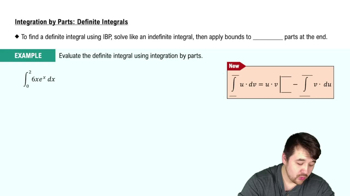
Integration by Parts for Definite Integrals
Trigonometric Functions
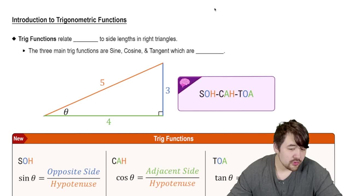
Trigonometric functions, such as sine, cosine, and tangent, are essential in calculus, particularly when dealing with integrals involving angles. The function tan(x) is defined as the ratio of the opposite side to the adjacent side in a right triangle. Recognizing the relationships between trigonometric functions and their identities can simplify the integration process, especially in integrals involving tan(x).
Recommended video:
Guided course
Introduction to Trigonometric Functions
Substitution Method
The substitution method is a technique used in integration to simplify the integrand by changing variables. This method involves substituting a part of the integral with a new variable, which can make the integral easier to evaluate. For the integral ∫ 1/(1 + tanx) dx, using a substitution related to the tangent function can help transform the integral into a more manageable form.
Recommended video:
Euler's Method
Related Practice
Textbook Question
1
views
Textbook Question
23-64. Integration Evaluate the following integrals.
50. ∫ 8(x² + 4)/[x(x² + 8)] dx
1
views
Textbook Question
7–58. Improper integrals Evaluate the following integrals or state that they diverge.
36. ∫ (from e² to ∞) 1/(x lnᵖ x) dx, p > 1
1
views
Textbook Question
48. Integral of sec³x Use integration by parts to show that:
∫ sec³x dx = (1/2) secx tanx + (1/2) ∫ secx dx
Textbook Question
95–98. {Use of Tech} Numerical methods Use numerical methods or a calculator to approximate the following integrals as closely as possible. The exact value of each integral is given.
96. ∫(from 0 to ∞) (sin²x)/x² dx = π/2
1
views
Textbook Question
66. Integrating derivatives
Use integration by parts to show that if f' is continuous on [a, b], then
∫[a to b] f(x)f'(x) dx = (1/2)[f(b)² - f(a)²]
1
views