Ch. 8 - Integration Techniques
Briggs - Calculus: Early Transcendentals 3rd Edition
Briggs3rd EditionCalculus: Early TranscendentalsISBN: 9780136847243Not the one you use?Change textbook
Chapter 8, Problem 8.6.7

7–84. Evaluate the following integrals.
7. ∫ from 0 to π/2 [sin θ / (1 + cos² θ)] dθ

Verified step by step guidance
1
Step 1: Recognize that the integral involves trigonometric functions. The integrand is sin(θ) / (1 + cos²(θ)). To simplify, consider substitution methods or trigonometric identities.
Step 2: Use the substitution u = cos(θ). Then, compute du = -sin(θ)dθ. This substitution will transform the integral into terms of u, making it easier to evaluate.
Step 3: Change the limits of integration according to the substitution. When θ = 0, u = cos(0) = 1. When θ = π/2, u = cos(π/2) = 0. The integral now has limits from u = 1 to u = 0.
Step 4: Rewrite the integral in terms of u. The original integral becomes ∫ from 1 to 0 [-du / (1 + u²)]. Notice the negative sign from du = -sin(θ)dθ.
Step 5: Reverse the limits of integration to remove the negative sign, resulting in ∫ from 0 to 1 [du / (1 + u²)]. This integral is now in a standard form, which can be evaluated using the arctangent function: ∫ [du / (1 + u²)] = arctan(u).

Verified video answer for a similar problem:

This video solution was recommended by our tutors as helpful for the problem above.
Video duration:
2m
Was this helpful?

Key Concepts

Here are the essential concepts you must grasp in order to answer the question correctly.

Definite Integrals

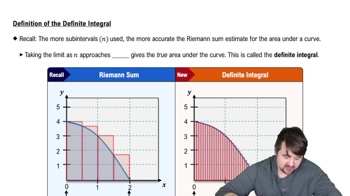
A definite integral calculates the accumulation of a quantity, represented as the area under a curve, between two specified limits. In this case, the integral is evaluated from 0 to π/2, meaning we are interested in the area under the curve of the function sin(θ) / (1 + cos²(θ)) from θ = 0 to θ = π/2.
Recommended video:
05:43
Definition of the Definite Integral

Trigonometric Functions

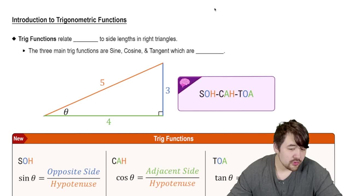
Trigonometric functions, such as sine and cosine, relate angles to ratios of sides in right triangles. Understanding these functions is crucial for evaluating integrals involving them, as they often appear in calculus problems. The integral in question involves sin(θ) and cos²(θ), which are fundamental in trigonometric identities and integration techniques.
Recommended video:
6:04
Introduction to Trigonometric Functions

Integration Techniques

Integration techniques are methods used to find the integral of a function, which can include substitution, integration by parts, or recognizing standard forms. For the given integral, recognizing the structure of the integrand and possibly using a substitution can simplify the evaluation process, making it easier to compute the area under the curve.
Recommended video:
06:18
Integration by Parts for Definite Integrals