
Ch. 8 - Integration Techniques
Briggs - Calculus: Early Transcendentals 3rd Edition
Briggs3rd EditionCalculus: Early TranscendentalsISBN: 9780136847243Not the one you use?Change textbook
Chapter 8, Problem 8.9.74

77–86. Comparison Test Determine whether the following integrals converge or diverge.
84. ∫(from 1 to ∞) (2 + cos x) / x² dx

Verified step by step guidance
1
Identify the integral to analyze: \(\int_{1}^{\infty} \frac{2 + \cos x}{x^{2}} \, dx\) and note that it is an improper integral because the upper limit is infinity.
Recall the Comparison Test for improper integrals: if \(0 \leq f(x) \leq g(x)\) for all \(x\) in \([1, \infty)\) and \(\int_{1}^{\infty} g(x) \, dx\) converges, then \(\int_{1}^{\infty} f(x) \, dx\) also converges.
Find a suitable function \(g(x)\) to compare with \(f(x) = \frac{2 + \cos x}{x^{2}}\). Since \(\cos x\) oscillates between \(-1\) and \(1\), the numerator \(2 + \cos x\) is bounded between \(1\) and \(3\). Therefore, \(\frac{2 + \cos x}{x^{2}} \leq \frac{3}{x^{2}}\) for all \(x \geq 1\).
Check the convergence of the comparison integral \(\int_{1}^{\infty} \frac{3}{x^{2}} \, dx\). Since \(\int_{1}^{\infty} \frac{1}{x^{2}} \, dx\) converges (p-integral with \(p=2 > 1\)), multiplying by a constant 3 does not affect convergence.
Conclude by the Comparison Test that since \(\int_{1}^{\infty} \frac{3}{x^{2}} \, dx\) converges and \(\frac{2 + \cos x}{x^{2}} \leq \frac{3}{x^{2}}\), the original integral \(\int_{1}^{\infty} \frac{2 + \cos x}{x^{2}} \, dx\) also converges.

Verified video answer for a similar problem:

This video solution was recommended by our tutors as helpful for the problem above.
Video duration:
4m
Was this helpful?

Key Concepts

Here are the essential concepts you must grasp in order to answer the question correctly.

Improper Integrals

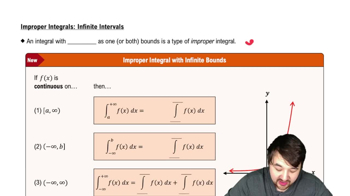
Improper integrals involve integration over an infinite interval or where the integrand has an infinite discontinuity. To evaluate convergence, we consider the limit of the integral as the upper bound approaches infinity. Understanding this concept is essential for determining whether the integral converges or diverges.
Recommended video:
11:11
Improper Integrals: Infinite Intervals

Comparison Test for Improper Integrals

The Comparison Test helps determine convergence by comparing the given integral to a simpler integral with known behavior. If the integrand is less than or equal to a function whose integral converges, then the original integral also converges. Conversely, if it is greater than or equal to a divergent integral, it diverges.
Recommended video:
11:11
Improper Integrals: Infinite Intervals

Behavior of Trigonometric Functions in Integrals

Trigonometric functions like cosine oscillate but remain bounded between -1 and 1. When combined with a decaying function such as 1/x², their oscillations do not affect convergence significantly. Recognizing this helps simplify the integral by focusing on the dominant term for convergence analysis.
Recommended video:
6:04
Introduction to Trigonometric Functions