Ch. 8 - Integration Techniques
Briggs - Calculus: Early Transcendentals 3rd Edition
Briggs3rd EditionCalculus: Early TranscendentalsISBN: 9780136847243Not the one you use?Change textbook
Chapter 8, Problem 8.7.74

71-74. Deriving formulas Evaluate the following integrals. Assume a and b are real numbers and n is a positive integer.
74. ∫xⁿ arcsin(x) dx (Hint: integration by parts.)

Verified step by step guidance
1
Step 1: Recall the formula for integration by parts: ∫u dv = uv - ∫v du. Choose u and dv wisely. For this integral, let u = arcsin(x) and dv = xⁿ dx. This choice is made because the derivative of arcsin(x) simplifies nicely, and xⁿ dx can be integrated easily.
Step 2: Compute du and v. Differentiate u = arcsin(x) to get du = (1 / √(1 - x²)) dx. Integrate dv = xⁿ dx to get v = (xⁿ⁺¹ / (n + 1)).
Step 3: Substitute u, v, du, and dv into the integration by parts formula: ∫xⁿ arcsin(x) dx = uv - ∫v du. This becomes (arcsin(x) * (xⁿ⁺¹ / (n + 1))) - ∫((xⁿ⁺¹ / (n + 1)) * (1 / √(1 - x²)) dx).
Step 4: Simplify the first term and focus on the second integral. The first term is straightforward: (arcsin(x) * xⁿ⁺¹) / (n + 1). The second integral requires further simplification and potentially substitution techniques to handle the √(1 - x²) term.
Step 5: Consider substitution for the second integral. Let z = √(1 - x²), which implies x = sin(θ) and dx = cos(θ) dθ. Rewrite the integral in terms of z or θ to simplify further. Continue solving step by step until the integral is fully evaluated.

Verified video answer for a similar problem:

This video solution was recommended by our tutors as helpful for the problem above.
Video duration:
3m
Was this helpful?

Key Concepts

Here are the essential concepts you must grasp in order to answer the question correctly.

Integration by Parts

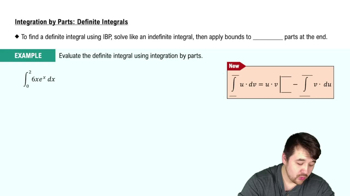
Integration by parts is a technique used to integrate products of functions. It is based on the product rule for differentiation and is expressed as ∫u dv = uv - ∫v du, where u and dv are chosen parts of the integrand. This method is particularly useful when one part of the product is easily integrable while the other is easily differentiable.
Recommended video:
06:18
Integration by Parts for Definite Integrals

Arcsine Function

The arcsine function, denoted as arcsin(x), is the inverse of the sine function, defined for values in the range [-1, 1]. It returns the angle whose sine is x. Understanding the properties and behavior of the arcsine function is crucial when integrating expressions involving it, as it often appears in calculus problems related to trigonometric identities.
Recommended video:
06:21
Properties of Functions

Polynomial Functions

Polynomial functions are expressions of the form f(x) = a_n x^n + a_(n-1) x^(n-1) + ... + a_1 x + a_0, where a_i are constants and n is a non-negative integer. In the context of integration, polynomials are straightforward to integrate, and their behavior can significantly influence the complexity of the integral when combined with other functions, such as arcsin(x).
Recommended video:
07:00
Taylor Polynomials