
Ch. 8 - Integration Techniques
Briggs - Calculus: Early Transcendentals 3rd Edition
Briggs3rd EditionCalculus: Early TranscendentalsISBN: 9780136847243Not the one you use?Change textbook
Chapter 8, Problem 8.4.23

7-56. Trigonometric substitutions Evaluate the following integrals using trigonometric substitution.
23. ∫ 1/(25 - x²)^(3/2) dx

Verified step by step guidance
1
Step 1: Recognize the integral involves a term of the form \( a^2 - x^2 \), which suggests using the trigonometric substitution \( x = a \sin(\theta) \). Here, \( a = 5 \) because \( 25 = 5^2 \). Substitute \( x = 5 \sin(\theta) \), and compute \( dx = 5 \cos(\theta) d\theta \).
Step 2: Substitute \( x = 5 \sin(\theta) \) and \( dx = 5 \cos(\theta) d\theta \) into the integral. The term \( 25 - x^2 \) becomes \( 25 - 25 \sin^2(\theta) \), which simplifies to \( 25 \cos^2(\theta) \) using the Pythagorean identity \( \sin^2(\theta) + \cos^2(\theta) = 1 \).
Step 3: Rewrite the integral in terms of \( \theta \): \( \int \frac{1}{(25 \cos^2(\theta))^{3/2}} \cdot 5 \cos(\theta) d\theta \). Simplify the denominator \( (25 \cos^2(\theta))^{3/2} \) to \( 125 \cos^3(\theta) \). The integral becomes \( \int \frac{5 \cos(\theta)}{125 \cos^3(\theta)} d\theta \).
Step 4: Simplify the fraction \( \frac{5 \cos(\theta)}{125 \cos^3(\theta)} \) to \( \frac{1}{25 \cos^2(\theta)} \). The integral now becomes \( \int \frac{1}{25 \cos^2(\theta)} d\theta \), which can be rewritten as \( \frac{1}{25} \int \sec^2(\theta) d\theta \).
Step 5: Evaluate \( \int \sec^2(\theta) d\theta \), which is a standard integral equal to \( \tan(\theta) \). After finding \( \tan(\theta) \), use the substitution \( \theta = \arcsin(x/5) \) to express the result back in terms of \( x \).

Verified video answer for a similar problem:

This video solution was recommended by our tutors as helpful for the problem above.
Video duration:
6m
Was this helpful?

Key Concepts

Here are the essential concepts you must grasp in order to answer the question correctly.

Trigonometric Substitution

Trigonometric substitution is a technique used in calculus to simplify integrals involving square roots of quadratic expressions. By substituting a variable with a trigonometric function, such as x = a sin(θ) or x = a tan(θ), the integral can often be transformed into a more manageable form. This method is particularly useful for integrals that contain expressions like √(a² - x²), √(x² + a²), or √(x² - a²).
Recommended video:
6:04
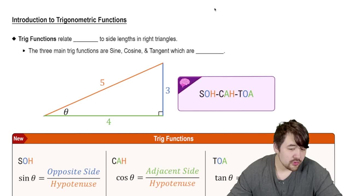
Introduction to Trigonometric Functions

Integral of Trigonometric Functions

Understanding the integrals of trigonometric functions is essential for evaluating integrals after substitution. Common integrals include ∫ sin(θ) dθ = -cos(θ) + C and ∫ cos(θ) dθ = sin(θ) + C. Familiarity with these integrals allows for the effective evaluation of the transformed integral, leading to the final solution after reverting back to the original variable.
Recommended video:
6:04
Introduction to Trigonometric Functions

Pythagorean Identity

The Pythagorean identity, sin²(θ) + cos²(θ) = 1, is a fundamental relationship in trigonometry that is often used in conjunction with trigonometric substitution. This identity helps simplify expressions involving trigonometric functions, especially when converting back to the original variable after integration. Recognizing how to manipulate this identity is crucial for solving integrals that arise from trigonometric substitutions.
Recommended video:
7:17
Verifying Trig Equations as Identities
Related Practice
Textbook Question

102–106. Laplace transforms A powerful tool in solving problems in engineering and physics is the Laplace transform. Given a function f(t), the Laplace transform is a new function F(s) defined by F(s) = ∫[0 to ∞] e^(-st) f(t) dt, where we assume s is a positive real number. For example, to find the Laplace transform of f(t) = e^(-t), the following improper integral is evaluated using integration by parts:

F(s) = ∫[0 to ∞] e^(-st) e^(-t) dt = ∫[0 to ∞] e^(-(s+1)t) dt = 1/(s+1).

Verify the following Laplace transforms, where a is a real number.

106. f(t) = cos(at) → F(s) = s/(s² + a²)

1
views
Textbook Question

87-92. An integrand with trigonometric functions in the numerator and denominator can often be converted to a rational function using the substitution u = tan(x/2) or, equivalently, x = 2 tan⁻¹u. The following relations are used in making this change of variables.

A: dx = 2/(1 + u²) du

B: sin x = 2u/(1 + u²)

C: cos x = (1 - u²)/(1 + u²)

88. Evaluate ∫ dx/(2 + cos x).

Textbook Question

9–61. Trigonometric integrals Evaluate the following integrals.

38. ∫ tan⁵θ sec⁴θ dθ

Textbook Question

79–82. {Use of Tech} Double table look-up The following integrals may require more than one table look-up. Evaluate the integrals using a table of integrals, and then check your answer with a computer algebra system.

82. ∫ (sin⁻¹(ax)) / x² dx, a > 0

1
views
Textbook Question

7–84. Evaluate the following integrals.

62. ∫ from 0 to π/2 √(1 + cosθ) dθ

Textbook Question

70. Different methods Let I=∫(x+2)/(x+4)dx.

b. Evaluate I without performing long division on the integrand.