Ch. 8 - Integration Techniques
Briggs - Calculus: Early Transcendentals 3rd Edition
Briggs3rd EditionCalculus: Early TranscendentalsISBN: 9780136847243Not the one you use?Change textbook
Chapter 8, Problem 8.8.67a

66–71. {Use of Tech} Estimating error Refer to Theorem 8.1 in the following exercises.
67. Let f(x) = √(x³ + 1).
a. Find a Midpoint Rule approximation to ∫[1 to 6] √(x³ + 1) dx using n = 50 subintervals.

Verified step by step guidance
1
Identify the integral to approximate: \(\int_{1}^{6} \sqrt{x^{3} + 1} \, dx\) and note that we will use the Midpoint Rule with \(n = 50\) subintervals.
Calculate the width of each subinterval using the formula \(\Delta x = \frac{b - a}{n}\), where \(a = 1\) and \(b = 6\). So, \(\Delta x = \frac{6 - 1}{50}\).
Determine the midpoints of each subinterval. For the \(i\)-th subinterval, the midpoint \(x_i^*\) is given by \(x_i^* = a + \left(i - \frac{1}{2}\right) \Delta x\) for \(i = 1, 2, \ldots, 50\).
Evaluate the function \(f(x) = \sqrt{x^{3} + 1}\) at each midpoint \(x_i^*\) to get \(f(x_i^*)\).
Form the Midpoint Rule approximation by summing the function values at the midpoints multiplied by the subinterval width: \(M_n = \Delta x \sum_{i=1}^{50} f(x_i^*)\).

Verified video answer for a similar problem:

This video solution was recommended by our tutors as helpful for the problem above.
Video duration:
5m
Was this helpful?

Key Concepts

Here are the essential concepts you must grasp in order to answer the question correctly.

Midpoint Rule for Numerical Integration

The Midpoint Rule approximates the definite integral of a function by dividing the interval into equal subintervals and using the function's value at each subinterval's midpoint to estimate the area. This method improves accuracy over using endpoints and is especially useful when the function is complex or lacks an elementary antiderivative.
Recommended video:
05:56
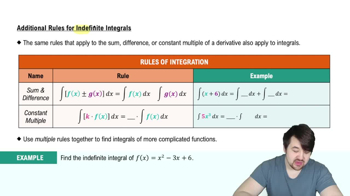
Additional Rules for Indefinite Integrals

Partitioning the Interval into Subintervals

To apply the Midpoint Rule, the interval [a, b] is divided into n equal subintervals, each of width Δx = (b - a)/n. The midpoints of these subintervals are then used to evaluate the function, which helps in approximating the integral by summing the areas of rectangles centered at these midpoints.
Recommended video:
08:44
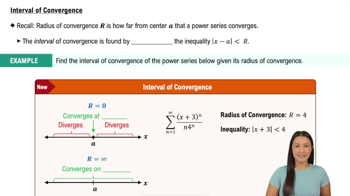
Interval of Convergence

Error Estimation in Numerical Integration

Error estimation provides a bound on the difference between the exact integral and its numerical approximation. Theorem 8.1 typically gives an error bound for the Midpoint Rule involving the second derivative of the function, helping to assess the accuracy of the approximation and determine if the chosen number of subintervals is sufficient.
Recommended video:
04:57
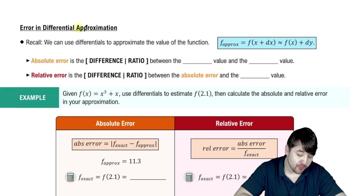
Determining Error and Relative Error