Ch. 8 - Integration Techniques
Briggs - Calculus: Early Transcendentals 3rd Edition
Briggs3rd EditionCalculus: Early TranscendentalsISBN: 9780136847243Not the one you use?Change textbook
Chapter 8, Problem 8.8.68a

66–71. {Use of Tech} Estimating error Refer to Theorem 8.1 in the following exercises.
68. Let f(x) = e^(x²).
a. Find a Trapezoid Rule approximation to ∫[0 to 1] e^(x²) dx using n = 50 subintervals.

Verified step by step guidance
1
Step 1: Recall the Trapezoid Rule formula for approximating definite integrals: \( T_n = \frac{\Delta x}{2} \left[ f(x_0) + 2f(x_1) + 2f(x_2) + \dots + 2f(x_{n-1}) + f(x_n) \right] \), where \( \Delta x = \frac{b-a}{n} \). Here, \( a = 0 \), \( b = 1 \), and \( n = 50 \).
Step 2: Calculate \( \Delta x \), the width of each subinterval: \( \Delta x = \frac{1 - 0}{50} = \frac{1}{50} \). This gives the spacing between the points \( x_0, x_1, \dots, x_{50} \).
Step 3: Determine the points \( x_i \) for \( i = 0, 1, \dots, 50 \) using \( x_i = a + i \Delta x \). For example, \( x_0 = 0 \), \( x_1 = \frac{1}{50} \), \( x_2 = \frac{2}{50} \), and so on up to \( x_{50} = 1 \).
Step 4: Evaluate \( f(x_i) = e^{x_i^2} \) at each of the points \( x_0, x_1, \dots, x_{50} \). For example, \( f(x_0) = e^{0^2} = e^0 = 1 \), \( f(x_1) = e^{(\frac{1}{50})^2} \), \( f(x_2) = e^{(\frac{2}{50})^2} \), and so on.
Step 5: Substitute the values of \( f(x_i) \) and \( \Delta x \) into the Trapezoid Rule formula to compute the approximation. Remember to multiply the first and last terms by 1 and all intermediate terms by 2, then sum them up and multiply by \( \frac{\Delta x}{2} \).

Verified video answer for a similar problem:

This video solution was recommended by our tutors as helpful for the problem above.
Video duration:
5m
Was this helpful?

Key Concepts

Here are the essential concepts you must grasp in order to answer the question correctly.

Trapezoidal Rule

The Trapezoidal Rule is a numerical integration technique that approximates the area under a curve by dividing it into trapezoids rather than rectangles. For a function f(x) over an interval [a, b], the area is estimated by calculating the average of the function values at the endpoints, multiplied by the width of the interval. This method improves accuracy compared to using rectangles, especially when the function is relatively linear over small subintervals.
Recommended video:

Numerical Integration

Numerical integration refers to a set of algorithms for calculating the integral of a function when an analytical solution is difficult or impossible to obtain. Techniques such as the Trapezoidal Rule and Simpson's Rule are commonly used to estimate definite integrals by approximating the area under the curve. These methods are particularly useful in applied mathematics, physics, and engineering, where exact solutions may not be feasible.
Recommended video:
6:47
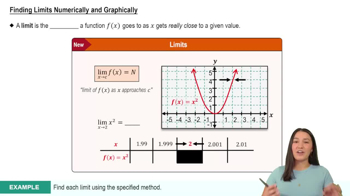
Finding Limits Numerically and Graphically

Error Estimation

Error estimation in numerical integration involves determining the difference between the exact value of an integral and its numerical approximation. Theorem 8.1 likely provides a framework for estimating this error, which can depend on factors such as the number of subintervals used and the behavior of the function being integrated. Understanding error estimation is crucial for assessing the reliability of numerical results and ensuring that they meet the required precision.
Recommended video:
04:57
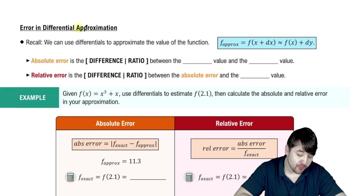
Determining Error and Relative Error