

Ch. 8 - Integration Techniques
Briggs - Calculus: Early Transcendentals 3rd Edition
Briggs3rd EditionCalculus: Early TranscendentalsISBN: 9780136847243Not the one you use?Change textbook
Chapter 8, Problem 8.3.65

65. Volume Find the volume of the solid generated when the region bounded by y = sin²(x) * cos^(3/2)(x) and the x-axis on the interval [0, π/2] is revolved about the x-axis.

Verified step by step guidance
1
Step 1: Recognize that the problem involves finding the volume of a solid of revolution. The formula for the volume when a region is revolved about the x-axis is given by: V = π ∫[a,b] f(x)² dx, where f(x) is the function describing the region and [a, b] is the interval of integration.
Step 2: Identify the function and interval from the problem. Here, the function is f(x) = sin²(x) * cos^(3/2)(x), and the interval is [0, π/2]. Substitute these into the volume formula.
Step 3: Set up the integral for the volume. The integral becomes: V = π ∫[0, π/2] (sin²(x) * cos^(3/2)(x))² dx. Simplify the integrand by squaring the function: (sin²(x) * cos^(3/2)(x))² = sin⁴(x) * cos³(x).
Step 4: Rewrite the integral with the simplified integrand: V = π ∫[0, π/2] sin⁴(x) * cos³(x) dx. To solve this integral, consider using trigonometric identities or substitution methods. For example, you might use the identity sin²(x) = 1 - cos²(x) to simplify further.
Step 5: Apply appropriate integration techniques, such as substitution or reduction formulas, to evaluate the integral. Once the integral is solved, multiply the result by π to find the volume. Ensure all steps are carefully followed to handle the trigonometric powers correctly.

Verified video answer for a similar problem:

This video solution was recommended by our tutors as helpful for the problem above.
Video duration:
2m

Key Concepts

Here are the essential concepts you must grasp in order to answer the question correctly.

Volume of Revolution

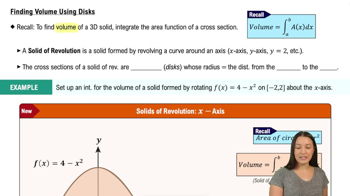
The volume of revolution refers to the volume of a solid formed by rotating a two-dimensional shape around an axis. In calculus, this is typically calculated using methods such as the disk method or the washer method, which involve integrating the area of circular cross-sections perpendicular to the axis of rotation.
Recommended video:
04:48
Finding Volume Using Disks

Definite Integral

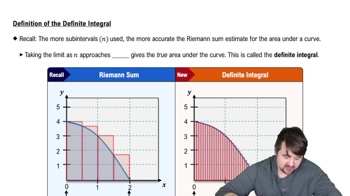
A definite integral calculates the accumulation of quantities, such as area or volume, over a specific interval. In this context, it is used to find the volume of the solid generated by revolving the given function around the x-axis, integrating from the lower to the upper bounds of the interval, [0, π/2].
Recommended video:
Guided course
05:43
Definition of the Definite Integral

Trigonometric Functions

Trigonometric functions, such as sine and cosine, are fundamental in calculus, especially when dealing with periodic phenomena. The function y = sin²(x) * cos^(3/2)(x) combines these functions, and understanding their behavior and properties is essential for evaluating the integral and determining the volume of the solid formed.
Recommended video:
Guided course
6:04
Introduction to Trigonometric Functions