
Ch. 8 - Integration Techniques
Briggs - Calculus: Early Transcendentals 3rd Edition
Briggs3rd EditionCalculus: Early TranscendentalsISBN: 9780136847243Not the one you use?Change textbook
Chapter 8, Problem 8.5.15

5–16. Set up the appropriate form of the partial fraction decomposition for the following expressions. Do not find the values of the unknown constants.
15. x / ((x⁴ - 16)²)

Verified step by step guidance
1
Recognize that the denominator is \( (x^4 - 16)^2 \), which is a repeated factor. First, factor \( x^4 - 16 \) as a difference of squares: \( x^4 - 16 = (x^2 - 4)(x^2 + 4) \).
Further factor \( x^2 - 4 \) as another difference of squares: \( x^2 - 4 = (x - 2)(x + 2) \). So the full factorization of the denominator is \( (x - 2)(x + 2)(x^2 + 4) \), and the entire denominator is \( [(x - 2)(x + 2)(x^2 + 4)]^2 \).
Since the denominator is squared, each factor appears with multiplicity 2. For partial fractions, include terms for each power from 1 up to 2 for each factor.
Set up the partial fraction decomposition as the sum of fractions with denominators \( (x - 2) \) and \( (x - 2)^2 \), \( (x + 2) \) and \( (x + 2)^2 \), and \( (x^2 + 4) \) and \( (x^2 + 4)^2 \). For linear factors, use constants in the numerators; for the irreducible quadratic \( x^2 + 4 \), use linear expressions in the numerator.
Write the decomposition as: \[ \frac{x}{(x^4 - 16)^2} = \frac{A}{x - 2} + \frac{B}{(x - 2)^2} + \frac{C}{x + 2} + \frac{D}{(x + 2)^2} + \frac{Ex + F}{x^2 + 4} + \frac{Gx + H}{(x^2 + 4)^2} \] where \( A, B, C, D, E, F, G, H \) are constants to be determined.

Verified video answer for a similar problem:

This video solution was recommended by our tutors as helpful for the problem above.
Video duration:
2m
Was this helpful?

Key Concepts

Here are the essential concepts you must grasp in order to answer the question correctly.

Partial Fraction Decomposition

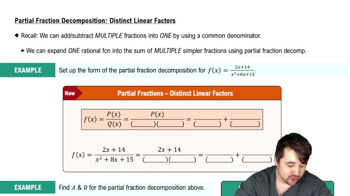
Partial fraction decomposition is a technique used to express a rational function as a sum of simpler fractions, making integration or other operations easier. It involves breaking down a complex rational expression into a sum of fractions with simpler denominators, typically linear or quadratic factors.
Recommended video:
10:07
Partial Fraction Decomposition: Distinct Linear Factors

Factorization of Polynomials

Factorization involves expressing a polynomial as a product of its irreducible factors. For partial fractions, correctly factoring the denominator into linear and/or irreducible quadratic factors is essential to set up the decomposition properly.
Recommended video:
07:00
Taylor Polynomials

Handling Repeated Factors in Partial Fractions

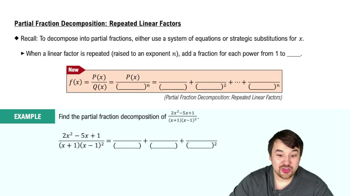
When the denominator contains repeated factors, each power of the repeated factor must be included separately in the decomposition. For example, if (x⁴ - 16) is squared, terms with denominators (x⁴ - 16) and (x⁴ - 16)² must both appear with unknown constants.
Recommended video:
11:26
Partial Fraction Decomposition: Repeated Linear Factors