73. Two methods Evaluate ∫ dx/(x² - 1), for x > 1, in two ways: using partial fractions and a trigonometric substitution. Reconcile your two answers.

Ch. 8 - Integration Techniques
Briggs3rd EditionCalculus: Early TranscendentalsISBN: 9780136847243Not the one you use?Change textbook
Chapter 8, Problem 8.2.42
42-47. Volumes of Solids Find the volume of the solid generated when the given region is revolved as described.
42. The region bounded by f(x) = ln(x), y = 1, and the coordinate axes is revolved about the x-axis.
Verified step by step guidance1
First, identify the region bounded by the curves: \(y = \ln(x)\), \(y = 1\), the \(x\)-axis (\(y=0\)), and the \(y\)-axis (\(x=0\)). Since \(\ln(x)\) is defined for \(x > 0\), the region lies between \(x=1\) (where \(\ln(1)=0\)) and \(x=e\) (where \(\ln(e)=1\)).
Set up the volume integral using the method of washers (disks with holes) since the solid is generated by revolving the region around the \(x\)-axis. The volume element is \(\pi \left(R^2 - r^2\right) dx\), where \(R\) is the outer radius and \(r\) is the inner radius of the washer at position \(x\).
Determine the outer and inner radii of the washers. The outer radius corresponds to the line \(y=1\), so \(R = 1\). The inner radius corresponds to the curve \(y = \ln(x)\), so \(r = \ln(x)\).
Write the volume integral as \(V = \int_{x=1}^{x=e} \pi \left(1^2 - (\ln(x))^2\right) dx = \pi \int_{1}^{e} \left(1 - (\ln(x))^2\right) dx\).
To find the volume, evaluate the integral \(\int_{1}^{e} \left(1 - (\ln(x))^2\right) dx\). This may require integration by parts or substitution for the \(\int (\ln(x))^2 dx\) term.

Verified video answer for a similar problem:
This video solution was recommended by our tutors as helpful for the problem above.
Video duration:
8mWas this helpful?
Key Concepts
Here are the essential concepts you must grasp in order to answer the question correctly.
Volume of Solids of Revolution
This concept involves finding the volume of a 3D solid formed by rotating a 2D region around an axis. Common methods include the disk/washer method and the shell method, which use integration to sum infinitesimal volumes of slices or shells.
Recommended video:
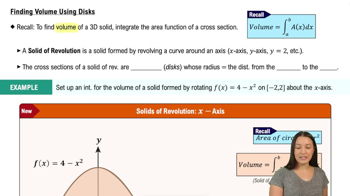
Finding Volume Using Disks
Disk/Washer Method
The disk/washer method calculates volume by slicing the solid perpendicular to the axis of rotation, forming circular disks or washers. The volume is found by integrating the area of these cross-sections along the axis of revolution.
Recommended video:
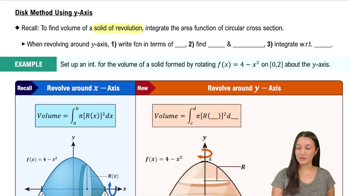
Disk Method Using y-Axis
Natural Logarithm Function and Its Graph
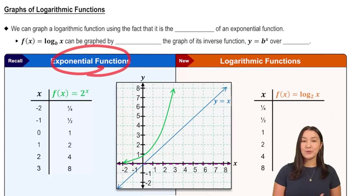
Understanding the function f(x) = ln(x) is essential, including its domain (x > 0), range, and shape. Knowing how it interacts with the lines y = 1 and the coordinate axes helps define the bounded region to be revolved.
Recommended video:
Graphs of Logarithmic Functions
Related Practice
Textbook Question
Textbook Question
54–57. {Use of Tech} Comparing the Midpoint and Trapezoid Rules Compare the errors in the Midpoint and Trapezoid Rules with n = 4, 8, 16, and 32 subintervals when they are applied to the following integrals (with their exact values given).
59. ∫(from 0 to π) ln(5 + 3cosx) dx = π ln(9/2)
Textbook Question
3. Describe the method used to integrate sin³x.
Textbook Question
5–16. Set up the appropriate form of the partial fraction decomposition for the following expressions. Do not find the values of the unknown constants.
6. (4x + 1)/(4x² - 1)
1
views
Textbook Question
7–58. Improper integrals Evaluate the following integrals or state that they diverge.
53. ∫ (from 0 to 1) ln x dx
1
views
Textbook Question
Evaluate the following integrals.
∫ eˣ/(e²ˣ + 2eˣ + 17) dx