Ch. 8 - Integration Techniques
Briggs - Calculus: Early Transcendentals 3rd Edition
Briggs3rd EditionCalculus: Early TranscendentalsISBN: 9780136847243Not the one you use?Change textbook
Chapter 8, Problem 8.5.57

23-64. Integration Evaluate the following integrals.
57. ∫ (x³ + 5x)/(x² + 3)² dx

Verified step by step guidance
1
Start by examining the integral \( \int \frac{x^{3} + 5x}{(x^{2} + 3)^{2}} \, dx \). Notice that the denominator is \( (x^{2} + 3)^{2} \), which suggests a substitution involving \( x^{2} + 3 \) might simplify the integral.
Let \( u = x^{2} + 3 \). Then, compute the differential \( du = 2x \, dx \), which implies \( x \, dx = \frac{du}{2} \). This substitution will help rewrite parts of the integral in terms of \( u \) and \( du \).
Rewrite the numerator \( x^{3} + 5x \) as \( x(x^{2} + 5) \). Using the substitution, express \( x^{3} + 5x = x(x^{2} + 5) = x(u - 3 + 5) = x(u + 2) \). This allows you to write the integral as \( \int \frac{x(u + 2)}{u^{2}} \, dx \).
Replace \( x \, dx \) with \( \frac{du}{2} \) from the substitution step, so the integral becomes \( \int \frac{u + 2}{u^{2}} \cdot \frac{du}{2} = \frac{1}{2} \int \frac{u + 2}{u^{2}} \, du \).
Split the integral into simpler terms: \( \frac{1}{2} \int \left( \frac{u}{u^{2}} + \frac{2}{u^{2}} \right) du = \frac{1}{2} \int \left( \frac{1}{u} + 2u^{-2} \right) du \). Now, integrate each term separately using the power rule and logarithmic integration.

Verified video answer for a similar problem:

This video solution was recommended by our tutors as helpful for the problem above.
Video duration:
6m
Was this helpful?

Key Concepts

Here are the essential concepts you must grasp in order to answer the question correctly.

Integration of Rational Functions

This involves integrating functions expressed as the ratio of two polynomials. Techniques often include polynomial division, substitution, or partial fraction decomposition to simplify the integral into manageable parts.
Recommended video:
6:04
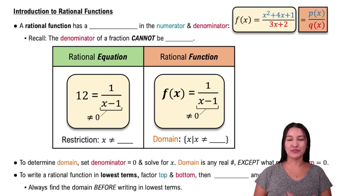
Intro to Rational Functions

Substitution Method

A technique where a part of the integral is replaced with a new variable to simplify the expression. For example, setting u = denominator or a function inside the integral can transform the integral into a standard form.
Recommended video:
07:33
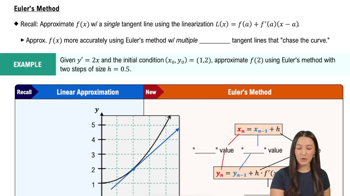
Euler's Method

Polynomial Division and Simplification

When the degree of the numerator is equal to or higher than the denominator, dividing polynomials can simplify the integrand. This step often precedes substitution or partial fractions to make integration straightforward.
Recommended video:
07:00
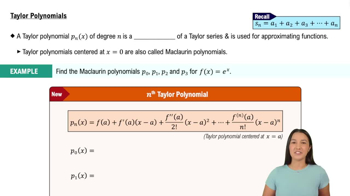
Taylor Polynomials
Related Practice
Textbook Question

62. Two integration methods Evaluate ∫ sin x cos x dx using integration by parts. Then evaluate the integral using a substitution. Reconcile your answers

Textbook Question

7-56. Trigonometric substitutions Evaluate the following integrals using trigonometric substitution.

9. ∫[5 to 5√3] √(100 - x²) dx

Textbook Question

37-40. {Use of Tech} Temperature data

Howdy temperature data for Boulder, Colorado; San Francisco, California; Nantucket, Massachusetts; and Duluth, Minnesota, over a 12-hr period on the same day of January are shown in the figure.

Assume these data are taken from a continuous temperature function T(t). The average temperature (in °F) over the 12-hr period is:

T_avg = (1/12) × ∫(0 to 12) T(t) dt

38. Find an accurate approximation to the average temperature over the 12-hr period for San Francisco. State your method.

Textbook Question

49–52. {Use of Tech} Simpson’s Rule

Apply Simpson’s Rule to the following integrals. It is easiest to obtain the Simpson’s Rule approximations from the Trapezoid Rule approximations, as in Example 8. Make a table similar to Table 8.8 showing the approximations and errors for n = 4, 8, 16, and 32. The exact values of the integrals are given for computing the error.

51. ∫(from 0 to π) e⁻ᵗ sin(t) dt = ½(e⁻ᵖⁱ + 1)

Textbook Question

9–61. Trigonometric integrals Evaluate the following integrals.

22. ∫[π/4 to π/2] sin²(2x) cos³(2x) dx

Textbook Question

7–84. Evaluate the following integrals.

35. ∫ from 0 to π/4 [(tan²θ + tanθ + 1) sec²θ] dθ