Ch. 8 - Integration Techniques
Briggs - Calculus: Early Transcendentals 3rd Edition
Briggs3rd EditionCalculus: Early TranscendentalsISBN: 9780136847243Not the one you use?Change textbook
Chapter 8, Problem 8.R.120

120. Equal volumes
a. Let R be the region bounded by the graph of f(x) = x^(-p) and the x-axis, for x ≥ 1. Let V₁ and V₂ be the volumes of the solids generated when R is revolved about the x-axis and the y-axis, respectively, if they exist. For what values of p (if any) is V₁ = V₂?
b. Repeat part (a) on the interval [0, 1].

Verified step by step guidance
1
Identify the region R bounded by the curve \(f(x) = x^{-p}\) and the x-axis for \(x \geq 1\) (part a) or \(x \in [0,1]\) (part b). This means the region lies between the curve and the x-axis over the specified interval.
Express the volume \(V_1\) generated by revolving R about the x-axis using the disk/washer method. The formula is: \[V_1 = \pi \int_a^b [f(x)]^2 \, dx = \pi \int_a^b x^{-2p} \, dx,\] where \([a,b]\) is the interval of integration (either \([1, \infty)\) for part a or \([0,1]\) for part b).
Express the volume \(V_2\) generated by revolving R about the y-axis using the shell method. The formula is: \[V_2 = 2\pi \int_a^b x \cdot f(x) \, dx = 2\pi \int_a^b x \cdot x^{-p} \, dx = 2\pi \int_a^b x^{1-p} \, dx,\] with the same interval \([a,b]\) as above.
Determine the conditions on \(p\) for which both \(V_1\) and \(V_2\) converge (i.e., the integrals are finite). This involves analyzing the improper integrals if the interval is infinite or near zero, and using the convergence criteria for integrals of the form \(\int x^m \, dx\).
Set the expressions for \(V_1\) and \(V_2\) equal to each other and solve for \(p\). This will involve evaluating the integrals symbolically (without computing the final numeric values), then equating the results and isolating \(p\) to find the values where \(V_1 = V_2\).

Verified video answer for a similar problem:

This video solution was recommended by our tutors as helpful for the problem above.
Video duration:
11m
Was this helpful?

Key Concepts

Here are the essential concepts you must grasp in order to answer the question correctly.

Volumes of Solids of Revolution

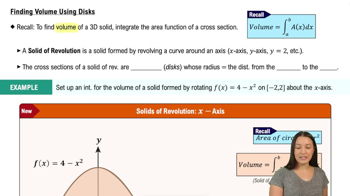
This concept involves finding the volume generated when a region is revolved around an axis. The volume can be computed using methods like the disk/washer method (for revolution about the x-axis) or the shell method (often used for revolution about the y-axis). Understanding how to set up and evaluate these integrals is essential for comparing volumes V₁ and V₂.
Recommended video:
04:48
Finding Volume Using Disks

Improper Integrals and Convergence

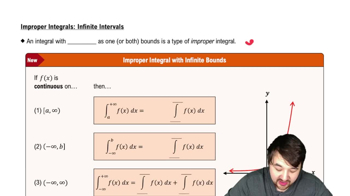
Since the region involves functions like f(x) = x^(-p) over infinite or boundary intervals, the integrals for volume may be improper. Determining for which values of p these integrals converge (exist) is crucial. This involves analyzing the behavior of the integrand near infinity or zero to ensure the volume is finite.
Recommended video:
11:11
Improper Integrals: Infinite Intervals

Function Behavior and Parameter Dependence

The function f(x) = x^(-p) changes shape depending on p, affecting the region R and the resulting volumes. Understanding how p influences the function's decay or growth helps determine when V₁ equals V₂. This requires comparing integrals with p as a parameter and solving for p values that satisfy the equality.
Recommended video:
Guided course
05:59
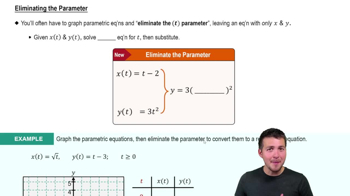
Eliminating the Parameter