Ch. 8 - Integration Techniques
Briggs - Calculus: Early Transcendentals 3rd Edition
Briggs3rd EditionCalculus: Early TranscendentalsISBN: 9780136847243Not the one you use?Change textbook
Chapter 8, Problem 8.R.114c

114. {Use of Tech} Arc length of the natural logarithm Consider the curve y = ln(x).
c. As a increases, L(a) increases as what power of a?

Verified step by step guidance
1
Recall the formula for the arc length \(L\) of a curve \(y = f(x)\) from \(x = 1\) to \(x = a\): \[L(a) = \int_1^a \sqrt{1 + \left(\frac{dy}{dx}\right)^2} \, dx\]
For the curve \(y = \ln(x)\), compute the derivative: \[\frac{dy}{dx} = \frac{1}{x}\]
Substitute the derivative into the arc length formula: \[L(a) = \int_1^a \sqrt{1 + \left(\frac{1}{x}\right)^2} \, dx = \int_1^a \sqrt{1 + \frac{1}{x^2}} \, dx = \int_1^a \sqrt{\frac{x^2 + 1}{x^2}} \, dx = \int_1^a \frac{\sqrt{x^2 + 1}}{x} \, dx\]
To understand how \(L(a)\) grows as \(a\) becomes large, analyze the behavior of the integrand \(\frac{\sqrt{x^2 + 1}}{x}\) for large \(x\). Simplify the integrand for large \(x\): \[\frac{\sqrt{x^2 + 1}}{x} = \frac{x \sqrt{1 + \frac{1}{x^2}}}{x} = \sqrt{1 + \frac{1}{x^2}}\] which approaches 1 as \(x \to \infty\).
Since the integrand approaches 1 for large \(x\), the arc length integral behaves roughly like \(\int_1^a 1 \, dx = a - 1\), which grows linearly with \(a\). Therefore, \(L(a)\) increases approximately as a power of \(a\) equal to 1.

Verified video answer for a similar problem:

This video solution was recommended by our tutors as helpful for the problem above.
Video duration:
5m
Was this helpful?

Key Concepts

Here are the essential concepts you must grasp in order to answer the question correctly.

Arc Length Formula

The arc length of a curve y = f(x) from x = a to x = b is given by the integral L = ∫_a^b √(1 + (dy/dx)^2) dx. This formula calculates the length of the curve by summing infinitesimal line segments along the curve.
Recommended video:
06:29
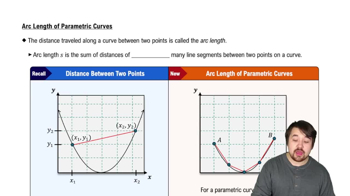
Arc Length of Parametric Curves

Derivative of the Natural Logarithm

For y = ln(x), the derivative dy/dx = 1/x. This derivative is essential in the arc length formula to find the integrand √(1 + (1/x)^2) = √(1 + 1/x^2), which determines how the slope affects the curve's length.
Recommended video:
05:18
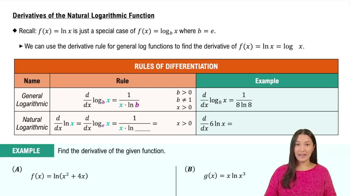
Derivative of the Natural Logarithmic Function

Asymptotic Behavior and Power Law Growth

Analyzing how L(a) grows as a increases involves understanding the dominant terms in the integral for large a. This helps determine the power of a that describes the growth rate of the arc length, often by approximating or bounding the integral.
Recommended video:
05:58
Intro to Power Series