Ch. 7 - Logarithmic, Exponential Functions, and Hyperbolic Functions
Briggs - Calculus: Early Transcendentals 3rd Edition
Briggs3rd EditionCalculus: Early TranscendentalsISBN: 9780136847243Not the one you use?Change textbook
Chapter 7, Problem 7.3.6

What is the domain of sech⁻¹ x? How is sech⁻¹ x defined in terms of the inverse hyperbolic cosine?

Verified step by step guidance
1
Step 1: Recall the definition of the hyperbolic secant function, sech(x), which is given by sech(x) = 1 / cosh(x), where cosh(x) is the hyperbolic cosine function.
Step 2: Understand that the inverse hyperbolic secant function, sech⁻¹(x), is defined for values of x within the domain of the hyperbolic secant function. Since sech(x) outputs values in the range (0, 1], the domain of sech⁻¹(x) is x ∈ (0, 1].
Step 3: Recognize that sech⁻¹(x) can be expressed in terms of the inverse hyperbolic cosine function, cosh⁻¹(x). Specifically, sech⁻¹(x) = cosh⁻¹(1/x), where 1/x must be greater than or equal to 1 to ensure the argument of cosh⁻¹ is valid.
Step 4: Verify that the domain of sech⁻¹(x) aligns with the range of sech(x). Since sech(x) is defined for all real numbers and outputs values in (0, 1], the domain of sech⁻¹(x) is restricted to x ∈ (0, 1].
Step 5: Conclude that the domain of sech⁻¹(x) is x ∈ (0, 1], and it is defined in terms of the inverse hyperbolic cosine as sech⁻¹(x) = cosh⁻¹(1/x).

Verified video answer for a similar problem:

This video solution was recommended by our tutors as helpful for the problem above.
Video duration:
3m
Was this helpful?

Key Concepts

Here are the essential concepts you must grasp in order to answer the question correctly.

Domain of a Function

The domain of a function refers to the set of all possible input values (x-values) for which the function is defined. For the inverse hyperbolic secant function, sech⁻¹ x, it is essential to determine the values of x that yield valid outputs. Understanding the domain helps in identifying the range of the function and ensures that calculations are performed within valid limits.
Recommended video:
5:10
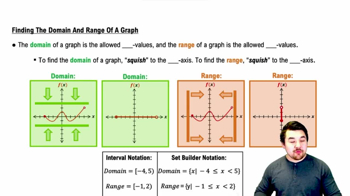
Finding the Domain and Range of a Graph

Inverse Hyperbolic Functions

Inverse hyperbolic functions are the inverses of hyperbolic functions, similar to how inverse trigonometric functions relate to trigonometric functions. The function sech⁻¹ x is defined as the inverse of the hyperbolic secant function, which is related to the hyperbolic cosine. This relationship allows us to express sech⁻¹ x in terms of the inverse hyperbolic cosine, specifically as sech⁻¹ x = cosh⁻¹(1/x) for x in the appropriate domain.
Recommended video:
5:50
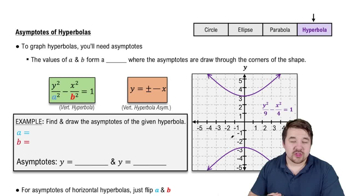
Asymptotes of Hyperbolas

Hyperbolic Functions

Hyperbolic functions, such as sinh, cosh, and sech, are analogs of trigonometric functions but are based on hyperbolas rather than circles. The hyperbolic secant function, sech(x), is defined as 1/cosh(x), where cosh(x) is the hyperbolic cosine. Understanding these functions is crucial for grasping the properties and definitions of their inverses, including sech⁻¹ x, and how they relate to real numbers and their geometric interpretations.
Recommended video:
5:50
Asymptotes of Hyperbolas