Ch. 7 - Logarithmic, Exponential Functions, and Hyperbolic Functions
Briggs - Calculus: Early Transcendentals 3rd Edition
Briggs3rd EditionCalculus: Early TranscendentalsISBN: 9780136847243Not the one you use?Change textbook
Chapter 7, Problem 7.2.35

Uranium dating Uranium-238 (U-238) has a half-life of 4.5 billion years. Geologists find a rock containing a mixture of U-238 and lead, and they determine that 85% of the original U-238 remains; the other 15% has decayed into lead. How old is the rock?

Verified step by step guidance
1
Identify the decay model for Uranium-238, which follows exponential decay. The amount of Uranium-238 remaining after time \(t\) can be modeled by the equation \(N(t) = N_0 e^{-kt}\), where \(N_0\) is the original amount, \(N(t)\) is the amount remaining at time \(t\), and \(k\) is the decay constant.
Use the half-life information to find the decay constant \(k\). The half-life \(T_{1/2}\) is related to \(k\) by the formula \(T_{1/2} = \frac{\ln(2)}{k}\). Rearranging gives \(k = \frac{\ln(2)}{T_{1/2}}\).
Substitute the given half-life of 4.5 billion years into the formula to calculate \(k\): \(k = \frac{\ln(2)}{4.5 \times 10^9}\) years\(^{-1}\).
Use the given information that 85% of the original Uranium-238 remains, so \(\frac{N(t)}{N_0} = 0.85\). Substitute this into the decay model: \(0.85 = e^{-kt}\).
Solve for the age \(t\) of the rock by taking the natural logarithm of both sides: \(\ln(0.85) = -kt\), then rearrange to find \(t = -\frac{\ln(0.85)}{k}\). Substitute the value of \(k\) from step 3 to express \(t\) in terms of known quantities.

Verified video answer for a similar problem:

This video solution was recommended by our tutors as helpful for the problem above.
Video duration:
4m
Was this helpful?

Key Concepts

Here are the essential concepts you must grasp in order to answer the question correctly.

Radioactive Decay and Half-Life

Radioactive decay is the process by which unstable nuclei lose energy by emitting radiation. The half-life is the time required for half of a given amount of a radioactive substance to decay. It is a constant property for each isotope and is used to determine the age of materials by measuring remaining radioactive atoms.
Recommended video:
09:29
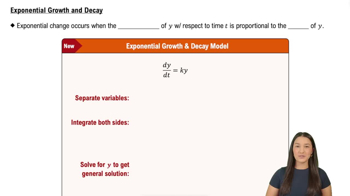
Exponential Growth & Decay

Exponential Decay Model

Radioactive decay follows an exponential decay model, where the quantity of a substance decreases at a rate proportional to its current amount. The formula N(t) = N0 * (1/2)^(t/T) relates the remaining amount N(t) to the initial amount N0, time t, and half-life T, allowing calculation of elapsed time from remaining material.
Recommended video:
09:29
Exponential Growth & Decay

Solving for Time in Decay Problems

To find the age of a sample, we solve the exponential decay equation for time t. Given the fraction of remaining substance and the half-life, logarithms are used to isolate t, enabling calculation of how long the decay has been occurring, which corresponds to the sample's age.
Recommended video:
05:03
Initial Value Problems