
Ch. 7 - Logarithmic, Exponential Functions, and Hyperbolic Functions
Briggs - Calculus: Early Transcendentals 3rd Edition
Briggs3rd EditionCalculus: Early TranscendentalsISBN: 9780136847243Not the one you use?Change textbook
Chapter 7, Problem 7.3.75a

Shallow-water velocity equation
a. Confirm that the linear approximation to ƒ(x) = tanh x at a = 0 is L(x) = x.

Verified step by step guidance
1
Recall that the linear approximation (or linearization) of a function \( f(x) \) at a point \( a \) is given by the formula: \[ L(x) = f(a) + f'(a)(x - a) \]
Identify the function and the point of approximation: here, \( f(x) = \tanh x \) and \( a = 0 \).
Calculate \( f(a) = \tanh 0 \). Since \( \tanh 0 = 0 \), this simplifies the linear approximation formula.
Find the derivative of \( f(x) = \tanh x \). Recall that \( \frac{d}{dx} \tanh x = \operatorname{sech}^2 x \).
Evaluate the derivative at \( a = 0 \): \( f'(0) = \operatorname{sech}^2 0 \). Since \( \operatorname{sech} 0 = 1 \), this gives \( f'(0) = 1 \). Substitute these values into the linear approximation formula to get \( L(x) = 0 + 1 \cdot (x - 0) = x \).

Verified video answer for a similar problem:

This video solution was recommended by our tutors as helpful for the problem above.
Video duration:
2m
Was this helpful?

Key Concepts

Here are the essential concepts you must grasp in order to answer the question correctly.

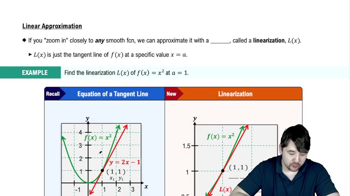
Linear Approximation (Linearization)

Linear approximation involves approximating a function near a point using the tangent line at that point. It is given by L(x) = f(a) + f'(a)(x - a), which simplifies calculations by replacing complex functions with linear ones close to a. This method is useful for estimating function values near the point a.
Recommended video:
07:17
Linearization

Derivative of tanh(x)

The derivative of tanh(x) is sech²(x), which measures the rate of change of tanh(x) at any point x. Evaluating this derivative at a specific point, such as x = 0, is essential for finding the slope of the tangent line used in linear approximation.
Recommended video:
04:56
Derivative of the Natural Exponential Function (e^x)

Properties of tanh(x) at x = 0

At x = 0, tanh(0) = 0, and its derivative f'(0) = sech²(0) = 1. These values simplify the linear approximation formula to L(x) = 0 + 1*(x - 0) = x, confirming that near zero, tanh(x) behaves approximately like the identity function.
Recommended video:
06:21
Properties of Functions
Related Practice
Textbook Question

Velocity of falling body Refer to Exercise 95, which gives the position function for a falling body. Use m = 75 kg and k = 0.2.


a. Confirm that the BASE jumper’s velocity t seconds after jumping is v(t) = d'(t) = √(mg/k) tanh (√(kg/m) t).

1
views
Textbook Question

A power line is attached at the same height to two utility poles that are separated by a distance of 100 ft; the power line follows the curve ƒ(x) = a cosh x/a. Use the following steps to find the value of a that produces a sag of 10 ft midway between the poles. Use a coordinate system that places the poles at x = ±50.


a. Show that a satisfies the equation cosh 50/a − 1 = 10/a.

1
views
Textbook Question

Energy consumption On the first day of the year (t=0), a city uses electricity at a rate of 2000 MW. That rate is projected to increase at a rate of 1.3% per year.


a. Based on these figures, find an exponential growth function for the power (rate of electricity use) for the city.

Textbook Question

Wave velocity Use Exercise 73 to do the following calculations.

a. Find the velocity of a wave where λ = 50 m and d = 20 m.

Textbook Question

Evaluating hyperbolic functions Evaluate each expression without using a calculator or state that the value does not exist. Simplify answers as much as possible.


a. cosh 0

Textbook Question

Falling body When an object falling from rest encounters air resistance proportional to the square of its velocity, the distance it falls (in meters) after t seconds is given by d(t) = (m/k) ln (cosh (√(kg/m) t)), where m is the mass of the object in kilograms, g = 9.8 m/s² is the acceleration due to gravity, and k is a physical constant.


a. A BASE jumper (m = 75 kg) leaps from a tall cliff and performs a ten-second delay (she free-falls for 10 s and then opens her chute). How far does she fall in 10 s? Assume k = 0.2.