Ch. 7 - Logarithmic, Exponential Functions, and Hyperbolic Functions
Briggs - Calculus: Early Transcendentals 3rd Edition
Briggs3rd EditionCalculus: Early TranscendentalsISBN: 9780136847243Not the one you use?Change textbook
Chapter 7, Problem 7.2.48

Rule of 70 Bankers use the Rule of 70, which says that if an account increases at a fixed rate of p%/yr, its doubling time is approximately 70/p. Use linear approximation to explain why and when this is true.

Verified step by step guidance
1
Start by expressing the doubling time problem in terms of exponential growth: if an amount grows at a rate of \(p\%\) per year, the amount after time \(t\) years is given by \(A(t) = A_0 e^{rt}\), where \(r = \frac{p}{100}\) is the growth rate as a decimal.
The doubling time \(T\) satisfies \(A(T) = 2A_0\), so we set up the equation \(2A_0 = A_0 e^{rT}\), which simplifies to \(2 = e^{rT}\).
Take the natural logarithm of both sides to solve for \(T\): \(\ln(2) = rT\), so \(T = \frac{\ln(2)}{r}\).
Use linear approximation by noting that \(\ln(2) \approx 0.693\), which is close to \(0.7\), and rewrite \(T\) as \(T \approx \frac{0.7}{r} = \frac{0.7}{p/100} = \frac{70}{p}\), which is the Rule of 70.
This approximation is valid when \(p\) is small because the exponential function can be closely approximated by its linearization near zero growth rates, making the Rule of 70 a good estimate for doubling time at modest growth rates.

Verified video answer for a similar problem:

This video solution was recommended by our tutors as helpful for the problem above.
Video duration:
3m
Was this helpful?

Key Concepts

Here are the essential concepts you must grasp in order to answer the question correctly.

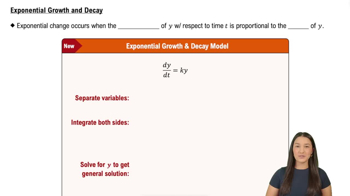
Exponential Growth and Doubling Time

Exponential growth describes how quantities increase at a rate proportional to their current value, leading to doubling over consistent intervals. The doubling time is the period it takes for an amount to double, which depends on the growth rate. Understanding this helps explain why the Rule of 70 approximates doubling time for fixed percentage growth.
Recommended video:
09:29
Exponential Growth & Decay

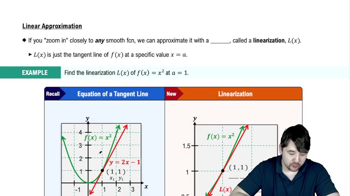
Linear Approximation (Differentials)

Linear approximation uses the tangent line at a point to estimate function values near that point. By approximating nonlinear functions with linear ones, we can simplify complex calculations. In this context, it helps approximate the natural logarithm function to derive the Rule of 70.
Recommended video:
07:17
Linearization

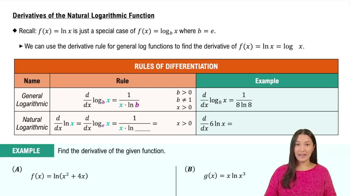
Natural Logarithm and Its Approximation

The natural logarithm function, ln(x), relates to continuous growth and is key in calculating exact doubling times. Near x = 1, ln(1 + r) ≈ r for small r, which allows simplification of the doubling time formula. This approximation underpins why dividing 70 by the percentage rate gives a close estimate.
Recommended video:
05:18
Derivative of the Natural Logarithmic Function