
Ch. 7 - Logarithmic, Exponential Functions, and Hyperbolic Functions
Briggs - Calculus: Early Transcendentals 3rd Edition
Briggs3rd EditionCalculus: Early TranscendentalsISBN: 9780136847243Not the one you use?Change textbook
Chapter 7, Problem 7.1.73c

Properties of exp(x) Use the inverse relations between ln x and exp(x), and the properties of ln x, to prove the following properties:


c. (exp(x))ᵖ = exp(px), p rational

Verified step by step guidance
1
Recall that the exponential function \( \exp(x) \) and the natural logarithm \( \ln(x) \) are inverse functions, meaning \( \ln(\exp(x)) = x \) for all real \( x \), and \( \exp(\ln(x)) = x \) for all \( x > 0 \).
Start with the expression \( (\exp(x))^{p} \), where \( p \) is a rational number. We want to rewrite this expression using the properties of logarithms and exponentials.
Apply the natural logarithm to \( (\exp(x))^{p} \) to use the logarithm power rule: \[ \ln\left((\exp(x))^{p}\right) = p \cdot \ln(\exp(x)) \].
Since \( \ln(\exp(x)) = x \), substitute this into the equation to get \[ \ln\left((\exp(x))^{p}\right) = p \cdot x \].
Now, exponentiate both sides to remove the logarithm: \[ (\exp(x))^{p} = \exp(p \cdot x) \]. This completes the proof of the property.

Verified video answer for a similar problem:

This video solution was recommended by our tutors as helpful for the problem above.
Video duration:
1m
Was this helpful?

Key Concepts

Here are the essential concepts you must grasp in order to answer the question correctly.

Inverse Relationship Between Exponential and Logarithmic Functions

The exponential function exp(x) and the natural logarithm ln(x) are inverses, meaning exp(ln(x)) = x for x > 0 and ln(exp(x)) = x for all real x. This relationship allows us to switch between the two functions to simplify expressions and prove properties.
Recommended video:
5:26
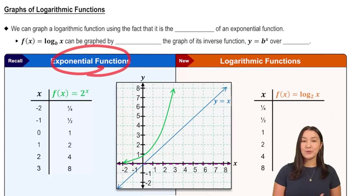
Graphs of Logarithmic Functions

Properties of the Natural Logarithm

The natural logarithm has key properties such as ln(a^b) = b ln(a) and ln(ab) = ln(a) + ln(b). These properties are essential for manipulating expressions involving powers and products, which help in proving identities involving exponentials.
Recommended video:
05:36
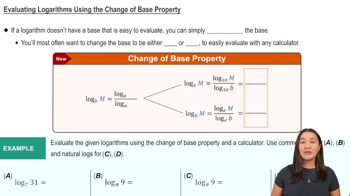
Change of Base Property

Exponentiation of the Exponential Function

Raising exp(x) to a rational power p means (exp(x))^p = exp(x)^p. Using the inverse and logarithm properties, this can be rewritten as exp(p x), showing how powers distribute over the exponential function when p is rational.
Recommended video:
6:13
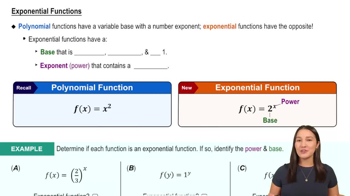
Exponential Functions