Ch. 7 - Logarithmic, Exponential Functions, and Hyperbolic Functions
Briggs - Calculus: Early Transcendentals 3rd Edition
Briggs3rd EditionCalculus: Early TranscendentalsISBN: 9780136847243Not the one you use?Change textbook
Chapter 7, Problem 7.2.25

Population of Texas Texas was the third fastest growing state in the United States in 2016. Texas grew from 25.1 million in 2010 to 26.47 million in 2016. Use an exponential growth model to predict the population of Texas in 2025.

Verified step by step guidance
1
Identify the exponential growth model formula: \(P(t) = P_0 \cdot e^{kt}\), where \(P(t)\) is the population at time \(t\), \(P_0\) is the initial population, \(k\) is the growth rate, and \(t\) is the time in years since the initial measurement.
Assign the known values: let \(t=0\) correspond to the year 2010, so \(P_0 = 25.1\) million, and at \(t=6\) (the year 2016), \(P(6) = 26.47\) million.
Use the known populations to find the growth rate \(k\) by substituting into the model: \(26.47 = 25.1 \cdot e^{6k}\). Solve this equation for \(k\) by isolating \(e^{6k}\) and then taking the natural logarithm.
Once \(k\) is found, use the model to predict the population in 2025 by calculating \(P(15) = 25.1 \cdot e^{15k}\), since 2025 is 15 years after 2010.
Interpret the result as the predicted population of Texas in 2025 according to the exponential growth model.

Verified video answer for a similar problem:

This video solution was recommended by our tutors as helpful for the problem above.
Video duration:
4m
Was this helpful?

Key Concepts

Here are the essential concepts you must grasp in order to answer the question correctly.

Exponential Growth Model

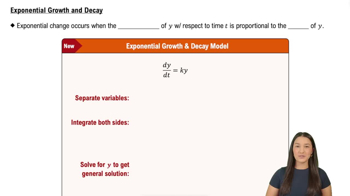
An exponential growth model describes a quantity that increases at a rate proportional to its current value, often expressed as P(t) = P_0 * e^(rt). Here, P_0 is the initial amount, r is the growth rate, and t is time. This model is used to predict populations or investments growing continuously over time.
Recommended video:
09:29
Exponential Growth & Decay

Determining the Growth Rate

The growth rate (r) in an exponential model is found by using known data points and solving for r in the equation P(t) = P_0 * e^(rt). By substituting the initial population, later population, and time elapsed, one can isolate r, which quantifies how fast the population grows per unit time.
Recommended video:
04:16
Intro To Related Rates

Using the Model to Make Predictions

Once the growth rate is known, the exponential model can predict future values by plugging in the desired time t. For example, to predict the population in 2025, substitute t as the number of years since the initial time (2010) into the model, allowing estimation of population size at that future date.
Recommended video:
10:17
Using The Velocity Function