
Ch. 7 - Logarithmic, Exponential Functions, and Hyperbolic Functions
Briggs - Calculus: Early Transcendentals 3rd Edition
Briggs3rd EditionCalculus: Early TranscendentalsISBN: 9780136847243Not the one you use?Change textbook
Chapter 7, Problem 7.RE.23a

Moore’s Law In 1965, Gordon Moore observed that the number of transistors that could be placed on an integrated circuit was approximately doubling each year, and he predicted that this trend would continue for another decade. In 1975, Moore revised the doubling time to every two years, and this prediction became known as Moore’s Law.


a. In 1979, Intel introduced the Intel 8088 processor; each of its integrated circuits contained 29,000 transistors. Use Moore’s revised doubling time to find a function y(t) that approximates the number of transistors on an integrated circuit t years after 1979.

Verified step by step guidance
1
Identify the initial value and the growth pattern: In 1979 (which corresponds to t = 0), the number of transistors is 29,000. This is our initial value, so \(y(0) = 29000\).
Understand the doubling time: According to Moore's revised law, the number of transistors doubles every 2 years. This means the quantity grows exponentially with a doubling period of 2 years.
Write the general form of the exponential growth function: Since the quantity doubles every 2 years, the function can be expressed as \(y(t) = y_0 \times 2^{\frac{t}{2}}\), where \(y_0\) is the initial number of transistors and \(t\) is the number of years after 1979.
Substitute the initial value into the function: Replace \(y_0\) with 29,000 to get \(y(t) = 29000 \times 2^{\frac{t}{2}}\).
Interpret the function: This function \(y(t)\) gives the approximate number of transistors on an integrated circuit \(t\) years after 1979, assuming the doubling every two years continues.

Verified video answer for a similar problem:

This video solution was recommended by our tutors as helpful for the problem above.
Video duration:
2m
Was this helpful?

Key Concepts

Here are the essential concepts you must grasp in order to answer the question correctly.

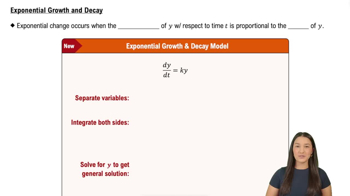
Exponential Growth

Exponential growth describes a process where a quantity increases by a consistent multiplicative rate over equal time intervals. In this context, the number of transistors doubles every fixed period, meaning the growth can be modeled by an exponential function of the form y(t) = y_0 * 2^(t/T), where y_0 is the initial amount and T is the doubling time.
Recommended video:
09:29
Exponential Growth & Decay

Doubling Time

Doubling time is the period it takes for a quantity undergoing exponential growth to double in size. Moore’s revised doubling time of two years means the number of transistors doubles every two years, which is crucial for setting the base of the exponential function modeling transistor count over time.
Recommended video:
02:32
Verifying Solutions of Differential Equations Example 3

Function Modeling with Initial Conditions

To create a function that models a real-world scenario, you use known initial values and growth rates. Here, the initial number of transistors in 1979 (29,000) serves as the starting value y(0), and the doubling time informs the growth rate, allowing construction of a function y(t) that predicts transistor counts for any year t after 1979.
Recommended video:
05:03
Initial Value Problems