Ch. 7 - Logarithmic, Exponential Functions, and Hyperbolic Functions
Briggs - Calculus: Early Transcendentals 3rd Edition
Briggs3rd EditionCalculus: Early TranscendentalsISBN: 9780136847243Not the one you use?Change textbook
Chapter 7, Problem 7.1.75

Bounds on e Use a left Riemann sum with at least n = 2 subintervals of equal length to approximate ln 2 = ∫[1 to 2] (dt/t) and show that ln 2 < 1. Use a right Riemann sum with n = 7 subintervals of equal length to approximate ln 3 = ∫[1 to 3] (dt/t) and show that ln 3 > 1.

Verified step by step guidance
1
First, recall that the natural logarithm function can be expressed as an integral: \(\ln b = \int_1^b \frac{1}{t} \, dt\) for \(b > 0\).
To approximate \(\ln 2 = \int_1^2 \frac{1}{t} \, dt\) using a left Riemann sum with \(n=2\) subintervals, divide the interval \([1,2]\) into 2 equal parts. Each subinterval has length \(\Delta t = \frac{2-1}{2} = 0.5\).
Identify the left endpoints of the subintervals: \(t_0 = 1\) and \(t_1 = 1.5\). Then, the left Riemann sum approximation is \(L_2 = \Delta t \left( \frac{1}{t_0} + \frac{1}{t_1} \right)\).
Since \(\frac{1}{t}\) is a decreasing function on \([1,2]\), the left Riemann sum overestimates the integral. Therefore, \(L_2 > \int_1^2 \frac{1}{t} \, dt = \ln 2\). Use this to show that \(\ln 2 < 1\) by evaluating the sum (without calculating the exact value here).
Next, to approximate \(\ln 3 = \int_1^3 \frac{1}{t} \, dt\) using a right Riemann sum with \(n=7\) subintervals, divide \([1,3]\) into 7 equal parts with \(\Delta t = \frac{3-1}{7} = \frac{2}{7}\). The right endpoints are \(t_i = 1 + i \Delta t\) for \(i=1\) to \(7\). The right Riemann sum is \(R_7 = \Delta t \sum_{i=1}^7 \frac{1}{t_i}\).
Since \(\frac{1}{t}\) is decreasing, the right Riemann sum underestimates the integral, so \(R_7 < \ln 3\). However, the problem asks to show \(\ln 3 > 1\), so you can compare \(R_7\) to 1 and use the inequality to conclude \(\ln 3 > 1\).

Verified video answer for a similar problem:

This video solution was recommended by our tutors as helpful for the problem above.
Video duration:
3m
Was this helpful?

Key Concepts

Here are the essential concepts you must grasp in order to answer the question correctly.

Riemann Sums

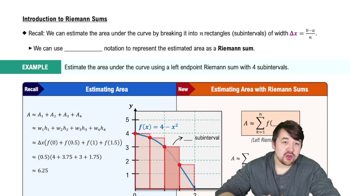
Riemann sums approximate the value of a definite integral by dividing the integration interval into subintervals and summing the areas of rectangles. The height of each rectangle is determined by the function value at specific points (left, right, or midpoint) within each subinterval. Increasing the number of subintervals generally improves the approximation.
Recommended video:
06:11
Introduction to Riemann Sums

Properties of the Natural Logarithm as an Integral

The natural logarithm function ln(x) can be expressed as an integral: ln(x) = ∫₁ˣ (1/t) dt. This integral representation allows us to approximate ln(x) by evaluating the integral numerically, such as with Riemann sums, linking logarithmic values to areas under the curve y = 1/t.
Recommended video:
05:36
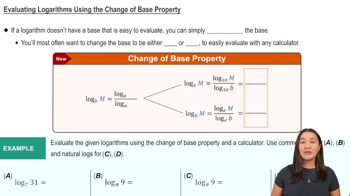
Change of Base Property

Inequalities from Left and Right Riemann Sums

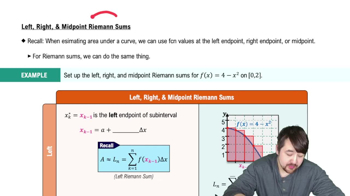
For a decreasing function, left Riemann sums overestimate the integral, while right Riemann sums underestimate it; for an increasing function, the opposite holds. Since 1/t is decreasing on [1, ∞), left sums provide upper bounds and right sums provide lower bounds, enabling inequalities like ln 2 < 1 and ln 3 > 1.
Recommended video:
07:39
Left, Right, & Midpoint Riemann Sums