Ch. 7 - Logarithmic, Exponential Functions, and Hyperbolic Functions
Briggs - Calculus: Early Transcendentals 3rd Edition
Briggs3rd EditionCalculus: Early TranscendentalsISBN: 9780136847243Not the one you use?Change textbook
Chapter 7, Problem 7.2.33

Atmospheric pressure The pressure of Earth’s atmosphere at sea level is approximately 1000 millibars and decreases exponentially with elevation. At an elevation of 30,000 ft (approximately the altitude of Mt. Everest), the pressure is one-third the sea-level pressure. At what elevation is the pressure half the sea-level pressure? At what elevation is it 1% of the sea-level pressure?

Verified step by step guidance
1
Identify the given information: the atmospheric pressure at sea level is \(P_0 = 1000\) millibars, and the pressure decreases exponentially with elevation \(h\). This means the pressure \(P(h)\) can be modeled as \(P(h) = P_0 e^{kh}\), where \(k\) is a constant to be determined and \(h\) is the elevation in feet.
Use the information at 30,000 ft to find the constant \(k\). At \(h = 30000\), the pressure is one-third of sea-level pressure, so \(P(30000) = \frac{1}{3} P_0\). Substitute into the model: \(\frac{1}{3} P_0 = P_0 e^{k \times 30000}\). Simplify to get \(\frac{1}{3} = e^{30000k}\).
Solve for \(k\) by taking the natural logarithm of both sides: \(\ln\left(\frac{1}{3}\right) = 30000k\), which gives \(k = \frac{\ln\left(\frac{1}{3}\right)}{30000}\).
Find the elevation \(h_{1/2}\) where the pressure is half the sea-level pressure: \(P(h_{1/2}) = \frac{1}{2} P_0\). Substitute into the model: \(\frac{1}{2} P_0 = P_0 e^{k h_{1/2}}\), which simplifies to \(\frac{1}{2} = e^{k h_{1/2}}\). Take the natural logarithm to solve for \(h_{1/2}\): \(\ln\left(\frac{1}{2}\right) = k h_{1/2}\), so \(h_{1/2} = \frac{\ln\left(\frac{1}{2}\right)}{k}\).
Similarly, find the elevation \(h_{0.01}\) where the pressure is 1% of sea-level pressure: \(P(h_{0.01}) = 0.01 P_0\). Substitute into the model: \(0.01 = e^{k h_{0.01}}\). Take the natural logarithm: \(\ln(0.01) = k h_{0.01}\), so \(h_{0.01} = \frac{\ln(0.01)}{k}\).

Verified video answer for a similar problem:

This video solution was recommended by our tutors as helpful for the problem above.
Video duration:
4m
Was this helpful?

Key Concepts

Here are the essential concepts you must grasp in order to answer the question correctly.

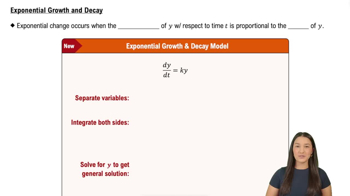
Exponential Decay

Exponential decay describes processes where a quantity decreases at a rate proportional to its current value. In this problem, atmospheric pressure decreases exponentially with elevation, meaning pressure drops rapidly at first and then more slowly as altitude increases.
Recommended video:
09:29
Exponential Growth & Decay

Pressure as a Function of Elevation

Atmospheric pressure at a given elevation can be modeled as P(h) = P0 * e^(-kh), where P0 is sea-level pressure, h is elevation, and k is a positive constant. Understanding this relationship allows calculation of pressure at any height by applying the exponential decay formula.
Recommended video:
06:21
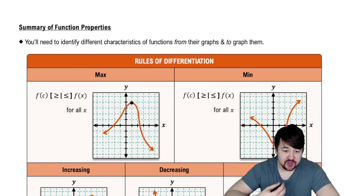
Properties of Functions

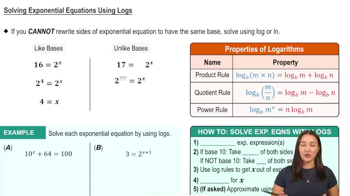
Solving for Variables in Exponential Equations

To find the elevation corresponding to a specific pressure, one must solve exponential equations by isolating the variable in the exponent. This typically involves taking natural logarithms to linearize the equation and then solving for the elevation.
Recommended video:
5:47
Solving Exponential Equations Using Logs