Ch. 7 - Logarithmic, Exponential Functions, and Hyperbolic Functions
Briggs - Calculus: Early Transcendentals 3rd Edition
Briggs3rd EditionCalculus: Early TranscendentalsISBN: 9780136847243Not the one you use?Change textbook
Chapter 7, Problem 7.2.12

After the introduction of foxes on an island, the number of rabbits on the island decreases by 4.5% per month. If y(t) equals the number of rabbits on the island t months after foxes were introduced, find the rate constant k for the exponential decay function y(t) = y₀eᵏᵗ.

Verified step by step guidance
1
Recognize that the problem describes an exponential decay process where the quantity decreases by a fixed percentage each month. The general form of the function is given as \(y(t) = y_0 e^{k t}\), where \(k\) is the rate constant we need to find.
Understand that a 4.5% decrease per month means that after 1 month, the population is 95.5% of the original, or mathematically, \(y(1) = 0.955 y_0\).
Substitute \(t = 1\) into the exponential decay formula: \(y(1) = y_0 e^{k \cdot 1} = y_0 e^{k}\).
Set the two expressions for \(y(1)\) equal to each other: \(y_0 e^{k} = 0.955 y_0\). Since \(y_0\) is not zero, divide both sides by \(y_0\) to get \(e^{k} = 0.955\).
Take the natural logarithm of both sides to solve for \(k\): \(k = \ln(0.955)\). This gives the rate constant for the exponential decay.

Verified video answer for a similar problem:

This video solution was recommended by our tutors as helpful for the problem above.
Video duration:
4m
Was this helpful?

Key Concepts

Here are the essential concepts you must grasp in order to answer the question correctly.

Exponential Decay Function

An exponential decay function models quantities that decrease at a rate proportional to their current value. It is generally expressed as y(t) = y₀e^{kt}, where k is a negative constant representing the decay rate, y₀ is the initial amount, and t is time.
Recommended video:
09:29
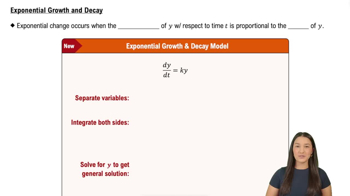
Exponential Growth & Decay

Rate Constant (k) in Exponential Decay

The rate constant k determines how quickly the quantity decreases over time. For decay, k is negative, and its magnitude relates to the percentage decrease per time unit. Finding k involves converting the given percentage decrease into a continuous decay rate.
Recommended video:
09:29
Exponential Growth & Decay

Converting Percentage Decrease to Continuous Decay Rate

A percentage decrease per time period can be converted to the continuous decay rate k by using the formula k = ln(1 - r), where r is the decimal form of the percentage decrease. This links discrete percentage changes to the continuous exponential model.
Recommended video:
04:16
Intro To Related Rates