
Ch. 7 - Logarithmic, Exponential Functions, and Hyperbolic Functions
Briggs - Calculus: Early Transcendentals 3rd Edition
Briggs3rd EditionCalculus: Early TranscendentalsISBN: 9780136847243Not the one you use?Change textbook
Chapter 7, Problem 7.RE.9

2–9. Integrals Evaluate the following integrals.


∫₀¹ (x² / (9 − x⁶)) dx

Verified step by step guidance
1
Identify the integral to be evaluated: \(\int_0^1 \frac{x^2}{9 - x^6} \, dx\).
Look for a substitution that simplifies the denominator. Notice that the denominator is \(9 - x^6\), and the numerator is \(x^2\). Consider substituting \(u = x^3\) because \(x^6 = (x^3)^2 = u^2\).
Compute the differential \(du\): since \(u = x^3\), then \(du = 3x^2 \, dx\), which implies \(x^2 \, dx = \frac{du}{3}\).
Rewrite the integral in terms of \(u\): change the limits accordingly. When \(x=0\), \(u=0^3=0\); when \(x=1\), \(u=1^3=1\). The integral becomes \(\int_0^1 \frac{1}{9 - u^2} \cdot \frac{du}{3}\).
Simplify the integral to \(\frac{1}{3} \int_0^1 \frac{1}{9 - u^2} \, du\). This is a standard integral that can be solved using partial fractions or recognizing it as a form related to inverse hyperbolic functions or logarithms.

Verified video answer for a similar problem:

This video solution was recommended by our tutors as helpful for the problem above.
Video duration:
5m
Was this helpful?

Key Concepts

Here are the essential concepts you must grasp in order to answer the question correctly.

Definite Integrals

A definite integral calculates the net area under a curve between two specific limits. It is represented as ∫_a^b f(x) dx, where a and b are the lower and upper bounds. Evaluating definite integrals often involves finding an antiderivative and then applying the Fundamental Theorem of Calculus.
Recommended video:
05:43
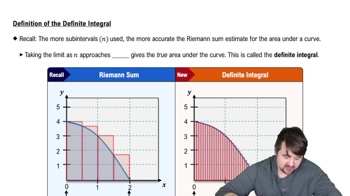
Definition of the Definite Integral

Substitution Method

The substitution method simplifies integrals by changing variables to transform the integral into a more manageable form. It involves choosing a substitution u = g(x) such that the integral in terms of u is easier to evaluate. This technique is especially useful when the integrand contains composite functions.
Recommended video:
07:33
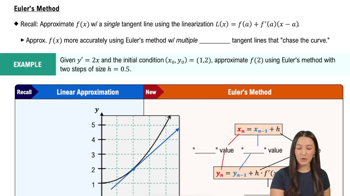
Euler's Method

Handling Rational Functions with Polynomial Denominators

Integrals involving rational functions with polynomial denominators often require algebraic manipulation or substitution to simplify. Recognizing patterns, such as powers in numerator and denominator, helps in choosing an appropriate substitution or partial fraction decomposition to evaluate the integral.
Recommended video:
06:11
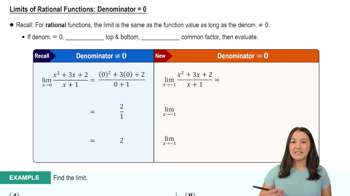
Limits of Rational Functions: Denominator = 0