Ch. 7 - Logarithmic, Exponential Functions, and Hyperbolic Functions
Briggs - Calculus: Early Transcendentals 3rd Edition
Briggs3rd EditionCalculus: Early TranscendentalsISBN: 9780136847243Not the one you use?Change textbook
Chapter 7, Problem 7.3.17

16–18. Identities Use the given identity to prove the related identity.


Use the identity cosh 2x = cosh²x + sinh²x to prove the identities cosh²x = (cosh 2x + 1)/2 and sinh²x = (cosh 2x − 1)/2.

Verified step by step guidance
1
Start with the given identity: cosh(2x) = cosh²(x) + sinh²(x). This is a fundamental hyperbolic trigonometric identity.
Recall the relationship between cosh²(x) and sinh²(x): cosh²(x) - sinh²(x) = 1. This is another key hyperbolic identity that will be useful.
Rearrange the first identity to isolate cosh²(x) and sinh²(x). Substitute sinh²(x) using the second identity: sinh²(x) = cosh²(x) - 1.
Plug this substitution into the original identity: cosh(2x) = cosh²(x) + (cosh²(x) - 1). Simplify the expression to get cosh(2x) = 2cosh²(x) - 1.
Rearrange the simplified expression to solve for cosh²(x): cosh²(x) = (cosh(2x) + 1)/2. Similarly, use the original identity to isolate sinh²(x): sinh²(x) = (cosh(2x) - 1)/2.

Verified video answer for a similar problem:

This video solution was recommended by our tutors as helpful for the problem above.
Video duration:
3m
Was this helpful?

Key Concepts

Here are the essential concepts you must grasp in order to answer the question correctly.

Hyperbolic Functions

Hyperbolic functions, such as sinh(x) and cosh(x), are analogs of the trigonometric functions but are based on hyperbolas instead of circles. They are defined as sinh(x) = (e^x - e^(-x))/2 and cosh(x) = (e^x + e^(-x))/2. Understanding these functions is crucial for manipulating identities involving them.
Recommended video:
5:50
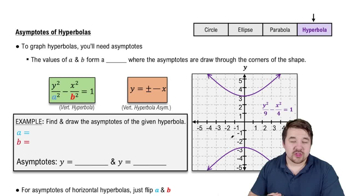
Asymptotes of Hyperbolas

Hyperbolic Identities

Hyperbolic identities are equations that hold true for hyperbolic functions, similar to trigonometric identities. The identity cosh(2x) = cosh²(x) + sinh²(x) is a fundamental relationship that can be used to derive other identities. Familiarity with these identities is essential for proving related statements.
Recommended video:
5:50
Asymptotes of Hyperbolas

Algebraic Manipulation

Algebraic manipulation involves rearranging and simplifying equations to prove identities or solve for variables. In the context of hyperbolic identities, this may include substituting known identities and performing operations like addition, subtraction, and factoring. Mastery of these techniques is necessary to derive the required identities from the given one.
Recommended video:
05:25
Determine Continuity Algebraically