
Ch. 6 - Applications of Integration
Briggs - Calculus: Early Transcendentals 3rd Edition
Briggs3rd EditionCalculus: Early TranscendentalsISBN: 9780136847243Not the one you use?Change textbook
Chapter 6, Problem 6.7.22

Work from force How much work is required to move an object from x=1 to x=3 (measured in meters) in the presence of a force (in N) given by F(x) = 2x² acting along the x-axis?

Verified step by step guidance
1
Identify that the work done by a variable force along the x-axis from position \(x=a\) to \(x=b\) is given by the definite integral of the force function: \(W = \int_{a}^{b} F(x) \, dx\).
Substitute the given force function \(F(x) = 2x^{2}\) and the limits of integration \(a=1\) and \(b=3\) into the integral: \(W = \int_{1}^{3} 2x^{2} \, dx\).
Set up the integral expression explicitly: \(W = 2 \int_{1}^{3} x^{2} \, dx\) to simplify the integration process.
Recall the integral formula for a power function: \(\int x^{n} \, dx = \frac{x^{n+1}}{n+1} + C\). Use this to find the antiderivative of \(x^{2}\), which is \(\frac{x^{3}}{3}\).
Evaluate the definite integral by applying the Fundamental Theorem of Calculus: compute \(2 \left[ \frac{x^{3}}{3} \right]_{1}^{3} = 2 \left( \frac{3^{3}}{3} - \frac{1^{3}}{3} \right)\) to express the work done.

Verified video answer for a similar problem:

This video solution was recommended by our tutors as helpful for the problem above.
Video duration:
1m
Was this helpful?

Key Concepts

Here are the essential concepts you must grasp in order to answer the question correctly.

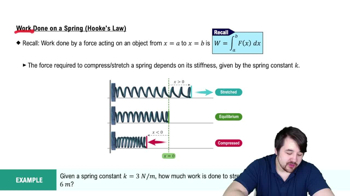
Work Done by a Variable Force

Work done by a force that varies with position is calculated by integrating the force function over the displacement interval. Specifically, work W = ∫ F(x) dx from the initial to the final position, capturing how the force changes along the path.
Recommended video:
05:40
Work Done On A Spring (Hooke's Law)

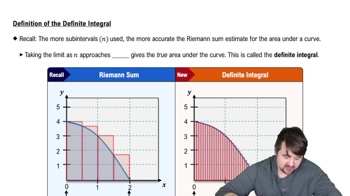
Definite Integral in Calculus

A definite integral computes the accumulation of quantities, such as area under a curve or total work done, between two limits. It sums infinitesimal contributions over an interval, providing an exact value for the total effect.
Recommended video:
05:43
Definition of the Definite Integral

Force as a Function of Position

When force depends on position, it must be expressed as a function F(x). Understanding this relationship allows us to apply calculus techniques to find work or energy, as the force magnitude changes with location along the x-axis.
Recommended video:
5:20
Relations and Functions