Ch. 6 - Applications of Integration
Briggs - Calculus: Early Transcendentals 3rd Edition
Briggs3rd EditionCalculus: Early TranscendentalsISBN: 9780136847243Not the one you use?Change textbook
Chapter 6, Problem 6.3.11

Use the general slicing method to find the volume of the following solids.
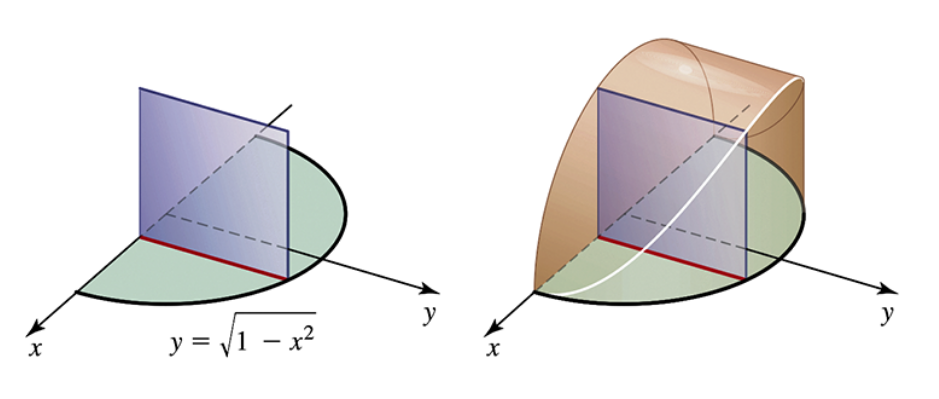
The solid whose base is the region bounded by the semicircle y=√1−x^2 and the x-axis, and whose cross sections through the solid perpendicular to the x-axis are squares
semi

Verified step by step guidance
1
Step 1: Understand the problem. The base of the solid is the region bounded by the semicircle y = √(1 − x²) and the x-axis. The cross-sections perpendicular to the x-axis are squares. This means the side length of each square is determined by the height of the semicircle at a given x-coordinate.
Step 2: Express the side length of the square. The side length of the square at a given x-coordinate is twice the y-value of the semicircle, which is 2√(1 − x²).
Step 3: Write the formula for the area of the square. The area of a square is the square of its side length. Therefore, the area of the square at a given x-coordinate is [2√(1 − x²)]² = 4(1 − x²).
Step 4: Set up the integral for the volume. The volume of the solid is obtained by integrating the area of the cross-sections along the x-axis over the interval where the semicircle exists. The semicircle spans from x = −1 to x = 1. Thus, the volume is given by V = ∫[−1, 1] 4(1 − x²) dx.
Step 5: Simplify the integral. Break the integral into simpler parts: V = ∫[−1, 1] 4 dx − ∫[−1, 1] 4x² dx. Evaluate each term separately to find the volume.

Verified video answer for a similar problem:

This video solution was recommended by our tutors as helpful for the problem above.
Video duration:
4m
Was this helpful?

Key Concepts

Here are the essential concepts you must grasp in order to answer the question correctly.

Volume of Solids of Revolution

The volume of solids of revolution can be calculated using integration techniques, particularly the disk or washer method. In this case, the solid is formed by rotating a region around an axis, and the volume is determined by integrating the area of cross-sectional slices perpendicular to that axis. Understanding this concept is crucial for applying the slicing method effectively.
Recommended video:
04:48
Finding Volume Using Disks

Cross Sections

Cross sections are the shapes obtained by slicing a three-dimensional object with a plane. In this problem, the cross sections of the solid are squares, which means that the area of each cross section can be expressed as a function of the variable x. This relationship is essential for setting up the integral to find the volume of the solid.
Recommended video:
05:38
Introduction to Cross Sections

Integration

Integration is a fundamental concept in calculus used to find areas, volumes, and other quantities that accumulate over a range. In this context, integration will be used to sum the areas of the square cross sections along the x-axis, from the leftmost to the rightmost bounds of the semicircle. Mastery of integration techniques is necessary to compute the total volume of the solid.
Recommended video:
06:18
Integration by Parts for Definite Integrals