
Ch. 6 - Applications of Integration
Briggs - Calculus: Early Transcendentals 3rd Edition
Briggs3rd EditionCalculus: Early TranscendentalsISBN: 9780136847243Not the one you use?Change textbook
Chapter 6, Problem 6.1.69

Suppose f and g have continuous derivatives on an interval [a, b]. Prove that if f(a)=g(a) and f(b)=g(b), then ∫a^b f′(x) dx = ∫a^b g′(x) dx.

Verified step by step guidance
1
Recall the Fundamental Theorem of Calculus, which states that if a function h has a continuous derivative on [a, b], then \( \int_a^b h'(x) \, dx = h(b) - h(a) \).
Apply the Fundamental Theorem of Calculus to the function \( f \), giving \( \int_a^b f'(x) \, dx = f(b) - f(a) \).
Similarly, apply the Fundamental Theorem of Calculus to the function \( g \), giving \( \int_a^b g'(x) \, dx = g(b) - g(a) \).
Use the given conditions \( f(a) = g(a) \) and \( f(b) = g(b) \) to substitute into the expressions for the integrals.
Conclude that since \( f(b) - f(a) = g(b) - g(a) \), it follows that \( \int_a^b f'(x) \, dx = \int_a^b g'(x) \, dx \), completing the proof.

Verified video answer for a similar problem:

This video solution was recommended by our tutors as helpful for the problem above.
Video duration:
2m
Was this helpful?

Key Concepts

Here are the essential concepts you must grasp in order to answer the question correctly.

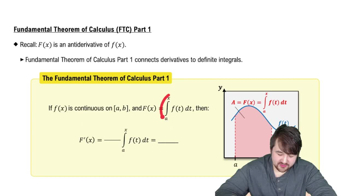
Fundamental Theorem of Calculus

This theorem links differentiation and integration, stating that if a function has a continuous derivative on [a, b], then the integral of its derivative over [a, b] equals the difference in the function's values at the endpoints: ∫a^b f'(x) dx = f(b) - f(a).
Recommended video:
06:11
Fundamental Theorem of Calculus Part 1

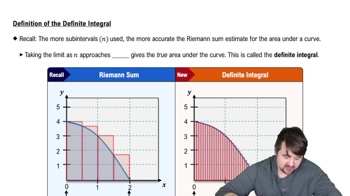
Properties of Definite Integrals

Definite integrals have linearity and additivity properties, allowing the comparison and manipulation of integrals. If two functions have equal values at the boundaries and continuous derivatives, their integrals of derivatives over the same interval can be equated.
Recommended video:
05:43
Definition of the Definite Integral

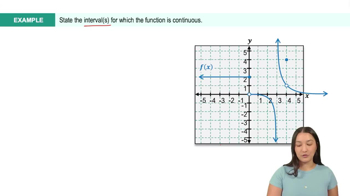
Continuity and Differentiability on Closed Intervals

For the Fundamental Theorem of Calculus to apply, functions must be differentiable with continuous derivatives on [a, b]. This ensures the integrals and function values behave predictably, allowing the use of endpoint values to evaluate integrals of derivatives.
Recommended video:
03:38
Intro to Continuity Example 1