Ch. 6 - Applications of Integration
Briggs - Calculus: Early Transcendentals 3rd Edition
Briggs3rd EditionCalculus: Early TranscendentalsISBN: 9780136847243Not the one you use?Change textbook
Chapter 6, Problem 6.2.1

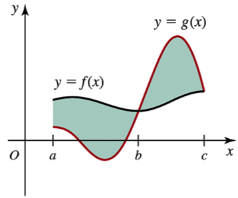
Set up a sum of two integrals that equals the area of the shaded region bounded by the graphs of the functions f and g on [a, c] (see figure). Assume the curves intersect at x=b.
Graph showing two curves, f(x) and g(x), with a shaded area between them from x=a to x=c, intersecting at x=b.

Verified step by step guidance
1
Identify the points of intersection of the two functions, which are given as x = a, x = b, and x = c. The shaded region lies between these points.
Determine which function is on top and which is on the bottom in each subinterval. From the graph, on the interval [a, b], the function f(x) is above g(x), and on the interval [b, c], the function g(x) is above f(x).
Set up the integral for the area on the interval [a, b] as the integral of the difference between the top function and the bottom function: \(\int_{a}^{b} (f(x) - g(x)) \, dx\).
Set up the integral for the area on the interval [b, c] as the integral of the difference between the top function and the bottom function: \(\int_{b}^{c} (g(x) - f(x)) \, dx\).
Express the total shaded area as the sum of the two integrals: \(\int_{a}^{b} (f(x) - g(x)) \, dx + \int_{b}^{c} (g(x) - f(x)) \, dx\).

Verified video answer for a similar problem:

This video solution was recommended by our tutors as helpful for the problem above.
Video duration:
2m
Was this helpful?

Key Concepts

Here are the essential concepts you must grasp in order to answer the question correctly.

Definite Integrals and Area Under a Curve

A definite integral calculates the net area between a function's graph and the x-axis over a specific interval. When the function lies above the x-axis, the integral represents the area directly; if below, it represents the negative area. Understanding this helps in setting up integrals to find areas bounded by curves.
Recommended video:
05:43
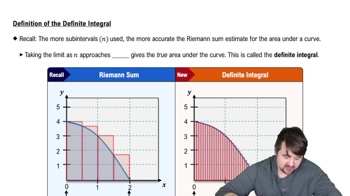
Definition of the Definite Integral

Area Between Two Curves

The area between two curves f(x) and g(x) over an interval [a, c] is found by integrating the difference of the functions, |f(x) - g(x)|, over that interval. When the curves intersect at x = b, the integral must be split at b to account for which function is on top in each subinterval.
Recommended video:
05:23
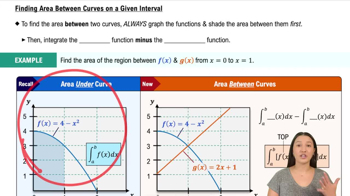
Finding Area Between Curves on a Given Interval

Splitting Integrals at Points of Intersection

When two curves intersect within the interval of interest, the relative position of the functions changes. To correctly compute the area between them, the integral is split at the intersection point, integrating the difference with the upper function minus the lower function on each subinterval separately.
Recommended video:
06:18
Integration by Parts for Definite Integrals