Ch. 6 - Applications of Integration
Briggs - Calculus: Early Transcendentals 3rd Edition
Briggs3rd EditionCalculus: Early TranscendentalsISBN: 9780136847243Not the one you use?Change textbook
Chapter 6, Problem 6.3.9c

Region R is revolved about the line y=1 to form a solid of revolution.


c. Write an integral for the volume of the solid.

Verified step by step guidance
1
Step 1: Identify the region R and the axis of rotation. The region R is revolved about the line y=1, which is a horizontal line above the x-axis. This indicates that the method of washers or shells may be appropriate for calculating the volume.
Step 2: Determine the method to use. Since the axis of rotation is horizontal, the washer method is typically used when the region is bounded by curves and the volume is calculated by subtracting the inner radius from the outer radius.
Step 3: Express the radii in terms of the variable of integration. The outer radius is the distance from y=1 to the outer curve, and the inner radius is the distance from y=1 to the inner curve. These distances should be expressed as functions of x or y, depending on the orientation of the region.
Step 4: Write the volume integral using the washer method formula: \( V = \pi \int_{a}^{b} \left[ R_{\text{outer}}^2 - R_{\text{inner}}^2 \right] \, dx \), where \( R_{\text{outer}} \) and \( R_{\text{inner}} \) are the radii expressed as functions of x, and \( a \) and \( b \) are the bounds of integration.
Step 5: Substitute the specific expressions for \( R_{\text{outer}} \) and \( R_{\text{inner}} \) into the integral, ensuring that the bounds of integration correspond to the region R. Simplify the integral expression to finalize the setup for calculating the volume.

Verified video answer for a similar problem:

This video solution was recommended by our tutors as helpful for the problem above.
Video duration:
2m
Was this helpful?

Key Concepts

Here are the essential concepts you must grasp in order to answer the question correctly.

Solid of Revolution

A solid of revolution is a three-dimensional shape created by rotating a two-dimensional region around a straight line (axis of rotation). The volume of such solids can be calculated using integral calculus, specifically through methods like the disk method or the washer method, depending on the shape of the region and the axis of rotation.
Recommended video:
04:48
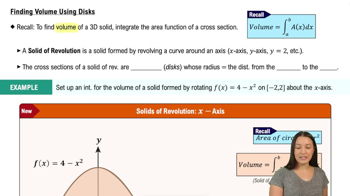
Finding Volume Using Disks

Volume Integral

The volume of a solid of revolution can be determined using volume integrals, which involve integrating the area of cross-sections perpendicular to the axis of rotation. For a region revolved around a horizontal line, the volume can be expressed as an integral of the form V = π ∫ [f(x) - k]^2 dx, where f(x) is the function defining the region and k is the line of rotation.
Recommended video:
04:48
Finding Volume Using Disks

Washer Method

The washer method is a technique used to find the volume of a solid of revolution when the region being revolved has a hole in the middle, resembling a washer. This method involves subtracting the volume of the inner solid from the volume of the outer solid, leading to an integral that accounts for both the outer and inner radii of the washers formed during the revolution.
Recommended video:
07:33
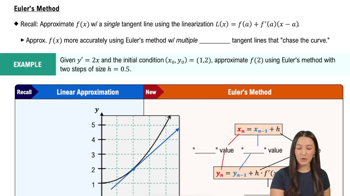
Euler's Method
Related Practice
Textbook Question

Work done by a spring A spring on a horizontal surface can be stretched and held 0.5 m from its equilibrium position with a force of 50 N.

b. How much work is done in compressing the spring 0.5 m from its equilibrium position?

Textbook Question

Probe speed A data collection probe is dropped from a stationary balloon, and it falls with a velocity (in m/s) given by v(t) = 9.8t, neglecting air resistance. After 10 s, a chute deploys and the probe immediately slows to a constant speed of 10 m/s, which it maintains until it enters the ocean.


c. If the probe was released from an altitude of 3 km, when does it enter the ocean?

Textbook Question

Oscillating growth rates Some species have growth rates that oscillate with an (approximately) constant period P. Consider the growth rate function N'(t) = r+A sin 2πt/P, where A and r are constants with units of individuals/yr, and t is measured in years. A species becomes extinct if its population ever reaches 0 after t=0.


c. Suppose P=10, A=50, and r=5. If the initial population is N(0)=10, does the population ever become extinct? Explain.

Textbook Question

Probe speed A data collection probe is dropped from a stationary balloon, and it falls with a velocity (in m/s) given by v(t) = 9.8t, neglecting air resistance. After 10 s, a chute deploys and the probe immediately slows to a constant speed of 10 m/s, which it maintains until it enters the ocean.


b. How far does the probe fall in the first 30 s after it is released?

Textbook Question

9–10. Velocity graphs The figures show velocity functions for motion along a line. Assume the motion begins with an initial position of s(0)=0. Determine the following.

c. The position at t=5

Textbook Question

Let R be the region bounded by the curve y=cos^−1x and the x-axis on [0, 1]. A solid of revolution is obtained by revolving R about the y-axis (see figures). 


b. Find an expression for the area A(y) of a cross section of the solid at a point y in [0,π/2].