
Ch. 6 - Applications of Integration
Briggs - Calculus: Early Transcendentals 3rd Edition
Briggs3rd EditionCalculus: Early TranscendentalsISBN: 9780136847243Not the one you use?Change textbook
Chapter 6, Problem 6.6.11

Find the area of the surface generated when the given curve is revolved about the given axis.


y=(3x)^1/3 , for 0≤x≤8/3; about the y-axis

Verified step by step guidance
1
Step 1: Recall the formula for the surface area of a curve revolved about the y-axis. The formula is: S = 2π ∫[a,b] x √(1 + (dy/dx)^2) dx, where x is the distance from the axis of rotation, and dy/dx is the derivative of the curve.
Step 2: Compute the derivative of the given curve y = (3x)^{1/3}. Using the power rule, dy/dx = (1/3)(3x)^{-2/3} * 3 = x^{-2/3}.
Step 3: Substitute dy/dx into the formula for surface area. The integrand becomes: x √(1 + (x^{-2/3})^2). Simplify the expression inside the square root: 1 + x^{-4/3}.
Step 4: Set up the definite integral for the surface area. The limits of integration are x = 0 to x = 8/3. The integral becomes: S = 2π ∫[0,8/3] x √(1 + x^{-4/3}) dx.
Step 5: Evaluate the integral either analytically or numerically to find the surface area. If solving analytically, consider substitution methods or numerical approximation techniques for complex integrals.

Verified video answer for a similar problem:

This video solution was recommended by our tutors as helpful for the problem above.
Video duration:
3m
Was this helpful?

Key Concepts

Here are the essential concepts you must grasp in order to answer the question correctly.

Surface Area of Revolution

The surface area of revolution is calculated by rotating a curve around an axis. The formula involves integrating the length of the curve multiplied by the radius of rotation. For a curve y=f(x) revolved around the y-axis, the surface area S can be expressed as S = 2π ∫ x * √(1 + (dy/dx)²) dx, where the integral is evaluated over the specified interval.
Recommended video:
09:07
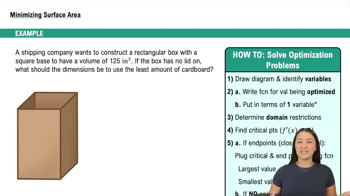
Example 1: Minimizing Surface Area

Parametric Representation

In some cases, curves can be represented parametrically, which is useful for calculating surface areas. For the given curve y=(3x)^(1/3), we can express x and y in terms of a parameter t. This allows us to derive the necessary derivatives and apply them in the surface area formula, especially when dealing with curves that are not easily expressed as functions of x.
Recommended video:
Guided course
08:02
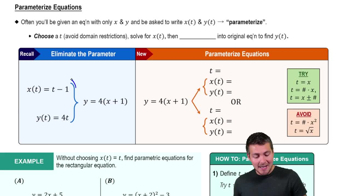
Parameterizing Equations

Integration Techniques

Integration techniques are essential for evaluating the integral that arises in the surface area calculation. This may involve methods such as substitution, integration by parts, or numerical integration if the integral cannot be solved analytically. Understanding these techniques is crucial for accurately finding the area of the surface generated by the revolution of the curve.
Recommended video:
06:18
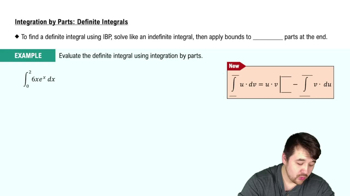
Integration by Parts for Definite Integrals