
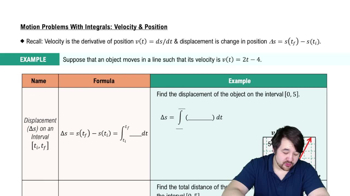
17–22. Position from velocity Consider an object moving along a line with the given velocity v and initial position.
a. Determine the position function, for t≥0, using the antiderivative method
v(t) = 9−t² on [0, 4]; s(0)=−2
Verified step by step guidance
17–22. Position from velocity Consider an object moving along a line with the given velocity v and initial position.
a. Determine the position function, for t≥0, using the antiderivative method
v(t) = 9−t² on [0, 4]; s(0)=−2
55–58. Marginal cost Consider the following marginal cost functions.
a. Find the additional cost incurred in dollars when production is increased from 100 units to 150 units.
C′(x) = 300+10x−0.01x²
Functions from arc length What differentiable functions have an arc length on the interval [a, b] given by the following integrals? Note that the answers are not unique. Give a family of functions that satisfy the conditions.
a. ∫a^b √1+16x⁴ dx
{Use of Tech} Oscillating motion A mass hanging from a spring is set in motion, and its ensuing velocity is given by v(t) = 2π cos πt, for t≥0. Assume the positive direction is upward and s(0)=0.
a. Determine the position function, for t≥0.
Depletion of natural resources Suppose r(t) = r0e^−kt, with k>0, is the rate at which a nation extracts oil, where r0=10⁷ barrels/yr is the current rate of extraction. Suppose also that the estimate of the total oil reserve is 2×10⁹ barrels.
a. Find Q(t), the total amount of oil extracted by the nation after t years.
For the given regions R₁ and R₂, complete the following steps.
a. Find the area of region R₁.
R₁is the region in the first quadrant bounded by the line x=1 and the curve y=6x(2−x^2)^2; R₂ is the region in the first quadrant bounded the curve y=6x(2−x^2)^2and the line y=6x.