
Ch. 6 - Applications of Integration
Briggs - Calculus: Early Transcendentals 3rd Edition
Briggs3rd EditionCalculus: Early TranscendentalsISBN: 9780136847243Not the one you use?Change textbook
Chapter 6, Problem 6.RE.1b

Explain why or why not Determine whether the following statements are true and give an explanation or counterexample.
b. Given only the velocity of an object moving on a line, it is possible to find its displacement, but not its position.

Verified step by step guidance
1
Recall the definitions: velocity is the rate of change of position with respect to time, and displacement is the change in position over a time interval.
Understand that displacement over a time interval \([a, b]\) can be found by integrating the velocity function \(v(t)\) over that interval: \(\text{displacement} = \int_a^b v(t) \, dt\).
Note that position at a specific time requires an initial position value \(s(a)\), because position is given by \(s(t) = s(a) + \int_a^t v(\tau) \, d\tau\).
Since velocity alone does not provide the initial position \(s(a)\), you cannot determine the exact position function \(s(t)\), only the displacement over intervals.
Therefore, the statement is true: given only velocity, you can find displacement by integration, but you cannot find the exact position without additional information.

Verified video answer for a similar problem:

This video solution was recommended by our tutors as helpful for the problem above.
Video duration:
2m
Was this helpful?

Key Concepts

Here are the essential concepts you must grasp in order to answer the question correctly.

Velocity and Displacement Relationship

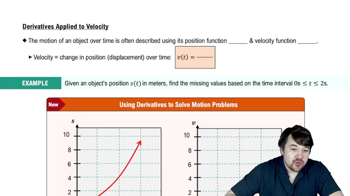
Velocity is the rate of change of position with respect to time, and displacement is the net change in position over a time interval. By integrating velocity over time, one can find the displacement, which measures how far and in what direction the object has moved from its initial position.
Recommended video:
06:29
Derivatives Applied To Velocity

Position as an Initial Value Problem

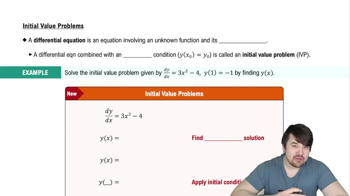
To determine the exact position of an object from its velocity, an initial position value is required. Without knowing where the object started, velocity alone only provides information about changes in position, not the absolute position at any given time.
Recommended video:
05:03
Initial Value Problems

Definite vs. Indefinite Integration in Kinematics

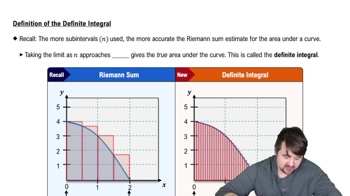
Integrating velocity to find displacement involves definite integration over a time interval, yielding a specific change in position. Finding position from velocity requires indefinite integration plus an initial condition, highlighting why velocity alone is insufficient to determine position uniquely.
Recommended video:
05:43
Definition of the Definite Integral
Related Practice
Textbook Question

2–3. Displacement, distance, and position Consider an object moving along a line with the following velocities and initial positions. Assume time t is measured in seconds and velocities have units of m/s.


d. Determine the position function s(t) using the Fundamental Theorem of Calculus (Theorem 6.1). Check your answer by finding the position function using the antiderivative method.


v(t) = 12t²-30t+12, for 0 ≤ t ≤ 3; s(0)=1

Textbook Question

Area and volume The region R is bounded by the curves x = y²+2,y=x−4, and y=0 (see figure).

a. Write a single integral that gives the area of R.

1
views
Textbook Question

Explain why or why not Determine whether the following statements are true and give an explanation or counterexample.

c. If water flows into a tank at a constant rate (for example, 6 gal/min), the volume of water in the tank increases according to a linear function of time.

Textbook Question

Variable gravity At Earth’s surface, the acceleration due to gravity is approximately g=9.8 m/s² (with local variations). However, the acceleration decreases with distance from the surface according to Newton’s law of gravitation. At a distance of y meters from Earth’s surface, the acceleration is given by a(y) = - g / (1+y/R)², where R=6.4×10⁶ m is the radius of Earth.


f. Graph ymax as a function of v0. What is the maximum height when v0=500 m/s,1500 m/s, and 5 km/s?

Textbook Question

70–72. Variable density in one dimension Find the mass of the following thin bars.


A bar on the interval 0≤x≤6 with a density ρ(x) = {1 if 0 ≤ x < 2

2 if 2 ≤ x < 4

4 if 4 ≤ x ≤ 6

1
views
Textbook Question

Fuel consumption A small plane in flight consumes fuel at a rate (in gal/min) given by

R'(t) ={ 4t^{1/3} if 0 ≤ t ≤ 8 (take-off)

2 if t> 0 (cruising)

a. Find a function R that gives the total fuel consumed, for 0≤t≤8.