Ch. 6 - Applications of Integration
Briggs - Calculus: Early Transcendentals 3rd Edition
Briggs3rd EditionCalculus: Early TranscendentalsISBN: 9780136847243Not the one you use?Change textbook
Chapter 6, Problem 6.7.63

Drinking juice A glass has circular cross sections that taper (linearly) from a radius of 5 cm at the top of the glass to a radius of 4 cm at the bottom. The glass is 15 cm high and full of orange juice. How much work is required to drink all the juice through a straw if your mouth is 5 cm above the top of the glass? Assume the density of orange juice equals the density of water.

Verified step by step guidance
1
Identify the physical setup: The glass is a frustum of a cone with a height of 15 cm, where the radius decreases linearly from 5 cm at the top to 4 cm at the bottom. The juice must be lifted to a point 5 cm above the top of the glass, so the total lifting height varies with the depth of the juice.
Set up a coordinate system: Let the vertical coordinate \( x \) measure the depth from the top of the glass downward, with \( x=0 \) at the top and \( x=15 \) at the bottom. The radius \( r(x) \) changes linearly from 5 cm at \( x=0 \) to 4 cm at \( x=15 \). Express \( r(x) \) as a linear function of \( x \).
Express the volume of a thin horizontal slice of juice: Consider a thin slice of thickness \( dx \) at depth \( x \). The volume of this slice is \( dV = \pi (r(x))^2 dx \).
Determine the work to lift this slice: The weight of the slice is \( dW_{weight} = \rho g dV \), where \( \rho \) is the density of the juice (same as water) and \( g \) is acceleration due to gravity. The distance this slice must be lifted is \( (x + 5) \) cm, since the juice at depth \( x \) must be raised to 5 cm above the top (which is at \( x=0 \)).
Set up the integral for total work: The total work is the integral from \( x=0 \) to \( x=15 \) of the weight of each slice times the lifting distance, i.e., \( W = \int_0^{15} \rho g \pi (r(x))^2 (x + 5) \, dx \). Substitute the expression for \( r(x) \) and constants, then evaluate the integral to find the total work.

Verified video answer for a similar problem:

This video solution was recommended by our tutors as helpful for the problem above.
Video duration:
7m
Was this helpful?

Key Concepts

Here are the essential concepts you must grasp in order to answer the question correctly.

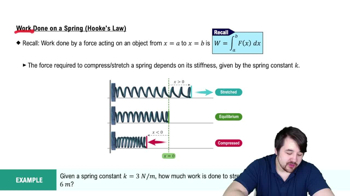
Work Done by a Variable Force

Work is the integral of force over distance. When force varies with position, such as lifting fluid layers at different heights, we sum infinitesimal amounts of work by integrating force times distance. This approach is essential for calculating the total work to move all juice through the straw.
Recommended video:
05:40
Work Done On A Spring (Hooke's Law)

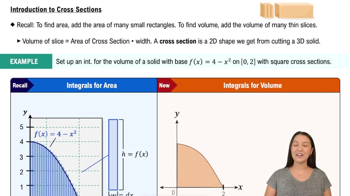
Volume and Cross-Sectional Area of a Tapered Cylinder

The glass has circular cross sections with radius changing linearly from 5 cm to 4 cm over 15 cm height. Understanding how to express the radius as a function of height allows calculation of the area at any slice, which is crucial for determining the volume and weight of each fluid layer.
Recommended video:
05:38
Introduction to Cross Sections

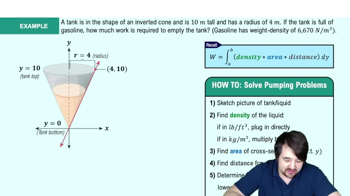
Hydrostatic Pressure and Fluid Weight

The weight of each fluid slice depends on its volume and density. Since density equals that of water, weight is density times volume times gravity. Calculating the force to lift each slice to the mouth height involves understanding how fluid weight relates to pressure and gravitational force.
Recommended video:
11:07
Pumping Liquids Example 2