
Ch. 6 - Applications of Integration
Briggs - Calculus: Early Transcendentals 3rd Edition
Briggs3rd EditionCalculus: Early TranscendentalsISBN: 9780136847243Not the one you use?Change textbook
Chapter 6, Problem 6.1.12b

Distance traveled and displacement Suppose an object moves along a line with velocity (in ft/s) v(t)=6−2t, for 0≤t≤6, where t is measured in seconds.


b. Find the displacement of the object on the interval 0≤t≤6.

Verified step by step guidance
1
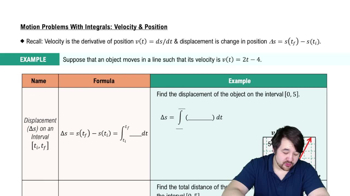
Recall that displacement over a time interval is the net change in position, which can be found by integrating the velocity function over that interval.
Set up the definite integral for displacement using the given velocity function \(v(t) = 6 - 2t\) over the interval \(0 \leq t \leq 6\): \[\int_0^6 (6 - 2t) \, dt\]
Integrate the function \(6 - 2t\) with respect to \(t\). The integral of \(6\) is \$6t\(, and the integral of \)-2t\( is \)-t^2$.
Evaluate the antiderivative at the upper and lower limits of the interval, \(t=6\) and \(t=0\), and subtract to find the displacement: \[\left[6t - t^2\right]_0^6 = (6 \times 6 - 6^2) - (6 \times 0 - 0^2)\]
Simplify the expression to find the net displacement of the object over the time interval.

Verified video answer for a similar problem:

This video solution was recommended by our tutors as helpful for the problem above.
Video duration:
2m
Was this helpful?

Key Concepts

Here are the essential concepts you must grasp in order to answer the question correctly.

Velocity and Displacement

Velocity is the rate of change of position with respect to time and can be positive or negative, indicating direction. Displacement is the net change in position over a time interval and is found by integrating the velocity function over that interval.
Recommended video:
10:17
Using The Velocity Function

Definite Integral as Net Change

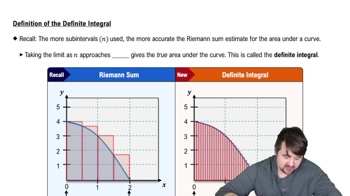
The definite integral of a velocity function from time a to b gives the net change in position, or displacement, during that time. It sums the signed areas under the velocity curve, accounting for direction.
Recommended video:
05:43
Definition of the Definite Integral

Evaluating Definite Integrals

To find displacement, compute the definite integral of v(t) from 0 to 6 by finding an antiderivative and applying the Fundamental Theorem of Calculus. This involves substituting the limits into the antiderivative and subtracting.
Recommended video:
05:43
Definition of the Definite Integral