
Ch. 6 - Applications of Integration
Briggs - Calculus: Early Transcendentals 3rd Edition
Briggs3rd EditionCalculus: Early TranscendentalsISBN: 9780136847243Not the one you use?Change textbook
Chapter 6, Problem 6.3.61a

"Determine whether the following statements are true and give an explanation or counterexample.


a. A pyramid is a solid of revolution. "

Verified step by step guidance
1
Step 1: Understand the concept of a solid of revolution. A solid of revolution is a three-dimensional shape created by rotating a two-dimensional region around an axis. Common examples include spheres, cylinders, and cones.
Step 2: Analyze the geometry of a pyramid. A pyramid is a polyhedron with a polygonal base and triangular faces that converge at a single point (the apex). It is not formed by rotating a two-dimensional region around an axis.
Step 3: Compare the formation of a pyramid to the definition of a solid of revolution. Since a pyramid is constructed by connecting the base to the apex with straight edges, it does not involve any rotational symmetry or revolution around an axis.
Step 4: Conclude whether the statement is true or false. Based on the analysis, a pyramid is not a solid of revolution because its shape does not result from rotation.
Step 5: Provide a counterexample to clarify. For instance, a cone is a solid of revolution because it can be formed by rotating a right triangle around one of its legs, whereas a pyramid cannot be formed in this way.

Verified video answer for a similar problem:

This video solution was recommended by our tutors as helpful for the problem above.
Video duration:
1m
Was this helpful?

Key Concepts

Here are the essential concepts you must grasp in order to answer the question correctly.

Solid of Revolution

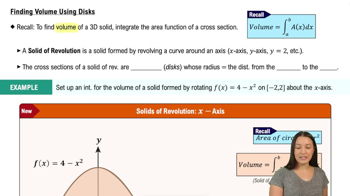
A solid of revolution is a three-dimensional shape created by rotating a two-dimensional shape around an axis. Common examples include spheres, cylinders, and cones, which are formed by rotating circles or triangles. Understanding this concept is crucial for distinguishing between solids of revolution and other types of solids.
Recommended video:
04:48
Finding Volume Using Disks

Pyramid

A pyramid is a polyhedron characterized by a polygonal base and triangular faces that converge at a single point called the apex. Unlike solids of revolution, pyramids do not arise from the rotation of a shape around an axis. Recognizing the geometric properties of pyramids helps clarify their classification in solid geometry.

Geometric Classification

Geometric classification involves categorizing shapes based on their properties and dimensions. This includes differentiating between solids of revolution, polyhedra, and other geometric forms. Understanding these classifications is essential for accurately assessing statements about geometric figures, such as whether a pyramid qualifies as a solid of revolution.
Recommended video:
Guided course
04:18
Geometric Sequences - Recursive Formula
Related Practice
Textbook Question

Emptying a conical tank A water tank is shaped like an inverted cone with height 6 m and base radius 1.5 m (see figure).

a. If the tank is full, how much work is required to pump the water to the level of the top of the tank and out of the tank?

1
views
Textbook Question

17–22. Position from velocity Consider an object moving along a line with the given velocity v and initial position.


a. Determine the position function, for t≥0, using the antiderivative method


v(t) = −t³+3t²−2t on [0, 3]; s(0)=4

Textbook Question

Critical depth A large tank has a plastic window on one wall that is designed to withstand a force of 90,000 N. The square window is 2 m on a side, and its lower edge is 1 m from the bottom of the tank.

a. If the tank is filled to a depth of 4 m, will the window withstand the resulting force?

1
views
Textbook Question

Oscillating growth rates Some species have growth rates that oscillate with an (approximately) constant period P. Consider the growth rate function N'(t) = r+A sin 2πt/P, where A and r are constants with units of individuals/yr, and t is measured in years. A species becomes extinct if its population ever reaches 0 after t=0.


a. Suppose P=10, A=20, and r=0. If the initial population is N(0)=10, does the population ever become extinct? Explain.

Textbook Question

Mass of two bars Two bars of length L have densities ρ₁(x) = 4e^−x and ρ₂(x) = 6e^−2x, for 0≤x≤L.

a. For what values of L is bar 1 heavier than bar 2?

1
views
Textbook Question

Determine whether the following statements are true and give an explanation or counterexample. 


a. If the curve y=f(x) on the interval [a, b] is revolved about the y-axis, the area of the surface generated is ∫f(b)f(a) 2πf(y)√1+f′(y)^2 dy.