Ch. 6 - Applications of Integration
Briggs - Calculus: Early Transcendentals 3rd Edition
Briggs3rd EditionCalculus: Early TranscendentalsISBN: 9780136847243Not the one you use?Change textbook
Chapter 6, Problem 6.R.56d

Comparing volumes Let R be the region bounded by y=1/x^p and the x-axis on the interval [1, a], where p>0 and a>1 (see figure). Let Vₓ and Vᵧ be the volumes of the solids generated when R is revolved about the x- and y-axes, respectively.


d. Find a general expression for Vᵧ in terms of a and p. Note that p=2 is a special case. What is Vᵧ when p=2?

Verified step by step guidance
1
Identify the region R bounded by the curve \(y = \frac{1}{x^p}\), the x-axis, and the vertical lines \(x=1\) and \(x=a\), where \(p > 0\) and \(a > 1\).
Since the solid is generated by revolving the region R about the y-axis, use the method of cylindrical shells to find the volume \(V_y\). The formula for the volume using cylindrical shells is: \[V_y = 2\pi \int_{x=1}^{a} (\text{radius})(\text{height}) \, dx\] where the radius is the distance from the y-axis to the shell (which is \(x\)), and the height is the function value \(y = \frac{1}{x^p}\).
Set up the integral for \(V_y\) as: \[V_y = 2\pi \int_1^a x \cdot \frac{1}{x^p} \, dx = 2\pi \int_1^a x^{1-p} \, dx\]
Evaluate the integral \(\int_1^a x^{1-p} \, dx\). For \(p \neq 2\), use the power rule for integration: \[\int x^{m} \, dx = \frac{x^{m+1}}{m+1} + C\] where \(m = 1 - p\). So, \[\int_1^a x^{1-p} \, dx = \left[ \frac{x^{2-p}}{2-p} \right]_1^a = \frac{a^{2-p} - 1}{2-p}\]
Substitute this back into the expression for \(V_y\) to get the general formula: \[V_y = 2\pi \cdot \frac{a^{2-p} - 1}{2-p}\] For the special case when \(p=2\), the integral becomes: \[\int_1^a x^{-1} \, dx = \left[ \ln x \right]_1^a = \ln a\] So, \[V_y = 2\pi \ln a\]

Verified video answer for a similar problem:

This video solution was recommended by our tutors as helpful for the problem above.
Video duration:
2m
Was this helpful?

Key Concepts

Here are the essential concepts you must grasp in order to answer the question correctly.

Volume of Solids of Revolution about the y-axis

When a region is revolved around the y-axis, the volume of the resulting solid can be found using the shell method. This involves integrating cylindrical shells with radius equal to the x-value and height given by the function, over the interval of x. The formula is V = 2π ∫ (radius)(height) dx.
Recommended video:
06:30
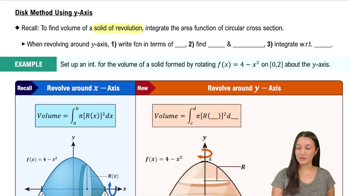
Disk Method Using y-Axis

Shell Method Integration Setup

The shell method requires expressing the volume integral in terms of x, where each shell's volume is 2π times the radius (distance from y-axis) times the height (function value) times the thickness dx. For y = 1/x^p, the height is 1/x^p and radius is x, integrated from 1 to a.
Recommended video:
07:33
Euler's Method

Handling Special Cases in Integration (p=2)

When p=2, the integral for volume may involve a logarithmic function or a different form due to the power rule's limitation at exponent -1. Recognizing and correctly evaluating this special case ensures an accurate volume expression without division by zero or undefined terms.
Recommended video:
04:24
Graphing The Derivative - Special Cases