Ch. 6 - Applications of Integration
Briggs - Calculus: Early Transcendentals 3rd Edition
Briggs3rd EditionCalculus: Early TranscendentalsISBN: 9780136847243Not the one you use?Change textbook
Chapter 6, Problem 6.1.65f

Bike race Theo and Sasha start at the same place on a straight road, riding bikes with the following velocities (measured in mi/hr). Assume t is measured in hours.
Theo: vT(t)=10, for t≥0
Sasha: vS(t)=15t, for 0≤t≤1, and vS(t)=15, for t>1


f. Suppose Sasha gives Theo a head start of 0.2 hr and the riders ride for 20 mi. Who wins the race?

Verified step by step guidance
1
First, understand the problem setup: Theo starts riding at time t = 0 with a constant velocity \(v_T(t) = 10\) mi/hr. Sasha starts after a head start of 0.2 hours, so Sasha's motion begins at \(t = 0.2\) hr, and Sasha's velocity is piecewise defined as \(v_S(t) = 15t\) for \(0 \leq t \leq 1\) and \(v_S(t) = 15\) for \(t > 1\) (where \(t\) is measured from Sasha's start time).
Calculate the time it takes for Theo to complete the 20-mile race. Since Theo's velocity is constant, use the formula for time: \(t_T = \frac{\text{distance}}{\text{velocity}} = \frac{20}{10}\). This gives the total time Theo rides from \(t=0\) until finishing.
For Sasha, note that Sasha starts at \(t=0.2\) hr (relative to the original clock). Define Sasha's travel time as \(t_S\) (time after Sasha starts). We need to find \(t_S\) such that the total distance Sasha covers equals 20 miles. Since Sasha's velocity changes at \(t_S=1\) hour, break the problem into two parts if needed: from \(0\) to \(1\) hour and from \(1\) hour onward.
Set up the distance function for Sasha by integrating the velocity over time. For \(0 \leq t_S \leq 1\), the distance is \(d_S(t_S) = \int_0^{t_S} 15u \, du\). For \(t_S > 1\), the distance is \(d_S(t_S) = \int_0^1 15u \, du + \int_1^{t_S} 15 \, du\). Solve for \(t_S\) such that \(d_S(t_S) = 20\) miles.
Compare the finishing times: Theo finishes at \(t = t_T\), and Sasha finishes at \(t = 0.2 + t_S\) (since Sasha started 0.2 hours later). The rider with the smaller finishing time wins the race.

Verified video answer for a similar problem:

This video solution was recommended by our tutors as helpful for the problem above.
Video duration:
4m
Was this helpful?

Key Concepts

Here are the essential concepts you must grasp in order to answer the question correctly.

Velocity and Speed Functions

Velocity functions describe how an object's speed changes over time. In this problem, Theo's velocity is constant, while Sasha's velocity changes piecewise, increasing linearly for the first hour and then remaining constant. Understanding these functions is essential to calculate the distance each rider covers over time.
Recommended video:
06:29
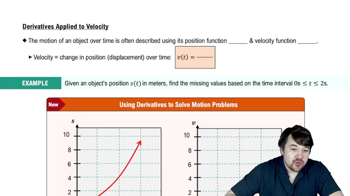
Derivatives Applied To Velocity

Distance as the Integral of Velocity

Distance traveled is found by integrating the velocity function over time. For constant velocity, distance equals velocity multiplied by time, but for variable velocity, the integral sums the changing speeds. This concept allows us to determine how long each rider takes to cover 20 miles.
Recommended video:
10:17
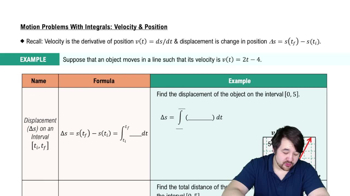
Using The Velocity Function

Time Delay and Relative Start Times

A head start means one rider begins earlier than the other, affecting their total travel time. Here, Theo starts 0.2 hours before Sasha, so Sasha's travel time is effectively reduced. Accounting for this delay is crucial to compare who reaches the 20-mile mark first.
Recommended video:
04:46
Determining Error and Relative Error Example 1