Ch. 6 - Applications of Integration
Briggs - Calculus: Early Transcendentals 3rd Edition
Briggs3rd EditionCalculus: Early TranscendentalsISBN: 9780136847243Not the one you use?Change textbook
Chapter 6, Problem 6.7.60a

A vertical spring A 10-kg mass is attached to a spring that hangs vertically and is stretched 2 m from the equilibrium position of the spring. Assume a linear spring with F(x) = kx.
a. How much work is required to compress the spring and lift the mass 0.5 m?

Verified step by step guidance
1
Identify the forces and displacements involved: The mass stretches the spring 2 m from its equilibrium position, so the spring constant \( k \) can be found using Hooke's Law \( F = kx \), where \( F \) is the weight of the mass and \( x \) is the displacement.
Calculate the spring constant \( k \) by setting the force equal to the weight of the mass: \( F = mg = kx \), where \( m = 10 \) kg, \( g = 9.8 \) m/s\^2, and \( x = 2 \) m. Rearrange to find \( k = \frac{mg}{x} \).
Determine the total displacement for the work calculation: compressing the spring and lifting the mass by 0.5 m means the spring is compressed from its stretched position by 0.5 m, so the new displacement from equilibrium is \( 2 - 0.5 = 1.5 \) m.
Set up the integral for the work done in compressing the spring from 2 m to 1.5 m using the formula for work done by a variable force: \( W = \int_{x_1}^{x_2} F(x) \, dx = \int_{1.5}^{2} kx \, dx \).
Evaluate the integral to find the work done: integrate \( kx \) with respect to \( x \) over the limits from 1.5 to 2, which gives \( W = \left[ \frac{kx^2}{2} \right]_{1.5}^{2} \). This expression represents the work required to compress the spring and lift the mass.

Verified video answer for a similar problem:

This video solution was recommended by our tutors as helpful for the problem above.
Video duration:
3m
Was this helpful?

Key Concepts

Here are the essential concepts you must grasp in order to answer the question correctly.

Hooke's Law

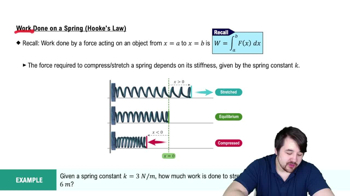
Hooke's Law states that the force exerted by a linear spring is proportional to its displacement from equilibrium, expressed as F(x) = kx, where k is the spring constant and x is the displacement. This relationship is fundamental for calculating forces and work involving springs.
Recommended video:
05:40
Work Done On A Spring (Hooke's Law)

Work Done by a Variable Force

When a force varies with position, the work done is found by integrating the force over the displacement. For a spring, work is calculated as the integral of F(x) = kx from the initial to final position, representing the energy required to compress or stretch the spring.
Recommended video:
05:40
Work Done On A Spring (Hooke's Law)

Gravitational Potential Energy

Lifting a mass against gravity increases its gravitational potential energy, calculated as mgh, where m is mass, g is acceleration due to gravity, and h is height. This energy must be included when determining the total work done in lifting the mass.
Recommended video:
05:59
Determining Concavity Given a Function
Related Practice
Textbook Question

55–58. Marginal cost Consider the following marginal cost functions.


a. Find the additional cost incurred in dollars when production is increased from 100 units to 150 units.


C′(x)=200−0.05x

Textbook Question

In the design of solid objects (both artificial and natural), the ratio of the surface area to the volume of the object is important. Animals typically generate heat at a rate proportional to their volume and lose heat at a rate proportional to their surface area. Therefore, animals with a low SAV ratio tend to retain heat, whereas animals with a high SAV ratio (such as children and hummingbirds) lose heat relatively quickly.


a. What is the SAV ratio of a cube with side lengths a?

Textbook Question

21–30. {Use of Tech} Arc length by calculator


a. Write and simplify the integral that gives the arc length of the following curves on the given interval. 

y = ln x, for 1≤x≤4

Textbook Question

Emptying a water trough A water trough has a semicircular cross section with a radius of 0.25 m and a length of 3 m (see figure).

a. How much work is required to pump the water out of the trough (to the level of the top of the trough) when it is full?

1
views
Textbook Question

17–22. Position from velocity Consider an object moving along a line with the given velocity v and initial position.


a. Determine the position function, for t≥0, using the antiderivative method


v(t) = 6−2t on [0, 5]; s(0)=0

1
views
Textbook Question

Region R is revolved about the line x=4 to form a solid of revolution.


a. What is the radius of a cross section of the solid at a point y in [1, 3]?