
Textbook Question
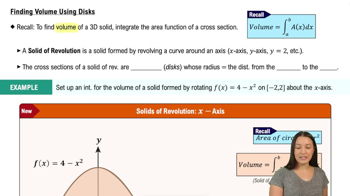
Equal integrals Without evaluating integrals, explain the following equalities. (Hint: Draw pictures.)
b. ∫²₀(25−(x²+1)²) dx = 2∫₁⁵ y√y−1 dy
1
views

 Verified step by step guidance
 04:48
04:48 04:48
04:48 07:36
07:36Equal integrals Without evaluating integrals, explain the following equalities. (Hint: Draw pictures.)
b. ∫²₀(25−(x²+1)²) dx = 2∫₁⁵ y√y−1 dy
Different axes of revolution Suppose R is the region bounded by y=f(x) and y=g(x) on the interval [a, b], where f(x)≥g(x).
b. How is this formula changed if x0>b?
Deceleration A car slows down with an acceleration of a(t) = −15 ft/s². Assume v(0)=60 ft/s,s(0)=0, and t is measured in seconds.
b. How far does the car travel in the time it takes to come to rest?
Volume of a sphere Let R be the region bounded by the upper half of the circle x²+y² = r² and the x-axis. A sphere of radius r is obtained by revolving R about the x-axis.
b. Repeat part (a) using the disk method.
Determine whether the following statements are true and give an explanation or counterexample.
b. If f is not one-to-one on the interval [a, b], then the area of the surface generated when the graph of f on [a, b] is revolved about the x-axis is not defined.
Let R be the region bounded by the curve y=cos^−1x and the x-axis on [0, 1]. A solid of revolution is obtained by revolving R about the y-axis (see figures).
b. Find an expression for the area A(y) of a cross section of the solid at a point y in [0,π/2].