
Ch. 6 - Applications of Integration
Briggs - Calculus: Early Transcendentals 3rd Edition
Briggs3rd EditionCalculus: Early TranscendentalsISBN: 9780136847243Not the one you use?Change textbook
Chapter 6, Problem 6.6.21

A 1.5-mm layer of paint is applied to one side of the following surfaces. Find the approximate volume of paint needed. Assume x and y are measured in meters. 


The spherical zone generated when the curve y=√8x−x^2 on the interval 1≤x≤7 is revolved about the x-axis 

Verified step by step guidance
1
Step 1: Recognize that the problem involves finding the volume of paint applied to a surface generated by revolving a curve about the x-axis. This requires using the formula for the volume of a solid of revolution. Specifically, the volume of the spherical zone can be approximated using the shell method or disk method.
Step 2: Write the formula for the volume of a solid of revolution using the disk method: V = π ∫[a,b] (y^2) dx, where y is the function describing the curve, and [a, b] is the interval of revolution. Here, y = √(8x − x^2) and the interval is [1, 7].
Step 3: Substitute the given function y = √(8x − x^2) into the formula. The integral becomes: V = π ∫[1,7] (8x − x^2) dx. Simplify the integrand by squaring the function.
Step 4: Compute the integral ∫[1,7] (8x − x^2) dx. Break it into two parts: ∫[1,7] 8x dx and ∫[1,7] x^2 dx. Use the power rule for integration: ∫x^n dx = (x^(n+1))/(n+1).
Step 5: After finding the volume of the solid of revolution, multiply the result by the thickness of the paint layer (1.5 mm = 0.0015 m) to approximate the volume of paint needed. This step involves scaling the surface area by the thickness of the paint layer.

Verified video answer for a similar problem:

This video solution was recommended by our tutors as helpful for the problem above.
Video duration:
6m
Was this helpful?

Key Concepts

Here are the essential concepts you must grasp in order to answer the question correctly.

Volume of Revolution

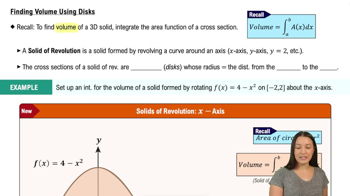
The volume of revolution refers to the volume of a solid formed by rotating a two-dimensional shape around an axis. In this case, the curve defined by y=√(8x−x²) is rotated about the x-axis, creating a three-dimensional shape. The volume can be calculated using the disk or washer method, which involves integrating the area of circular cross-sections perpendicular to the axis of rotation.
Recommended video:
04:48
Finding Volume Using Disks

Integration

Integration is a fundamental concept in calculus that allows us to find the area under a curve or the accumulation of quantities. In the context of finding the volume of the solid generated by the revolution of a curve, integration is used to sum up the infinitesimally small volumes of the disks or washers formed. The definite integral will be evaluated over the specified interval [1, 7] to determine the total volume.
Recommended video:
06:18
Integration by Parts for Definite Integrals

Surface Area and Volume of a Sphere

The surface area and volume of a sphere are important geometric properties that can be relevant when considering the application of paint. The volume of paint needed can be approximated by calculating the volume of the spherical zone created by the revolution of the curve. Understanding the relationship between the dimensions of the sphere and the thickness of the paint layer is essential for accurately estimating the total volume of paint required.
Recommended video:
09:07
Example 1: Minimizing Surface Area