
Ch. 6 - Applications of Integration
Briggs - Calculus: Early Transcendentals 3rd Edition
Briggs3rd EditionCalculus: Early TranscendentalsISBN: 9780136847243Not the one you use?Change textbook
Chapter 6, Problem 6.5.18

9–20. Arc length calculations Find the arc length of the following curves on the given interval.
x = 2e^√2y + 1/16e^−√2y, for 0 ≤ y ≤ ln²/√2

Verified step by step guidance
1
Identify the given function: \(x = 2e^{\sqrt{2}y} + \frac{1}{16}e^{-\sqrt{2}y}\), with the interval \(0 \leq y \leq \frac{(\ln 2)^2}{\sqrt{2}}\).
Recall the formula for the arc length of a curve defined as \(x = f(y)\) over an interval \([a, b]\): \[L = \int_a^b \sqrt{1 + \left(\frac{dx}{dy}\right)^2} \, dy\]
Compute the derivative \(\frac{dx}{dy}\): Differentiate each term of \(x\) with respect to \(y\) using the chain rule, noting that \(\frac{d}{dy} e^{k y} = k e^{k y}\).
Square the derivative \(\left(\frac{dx}{dy}\right)^2\) and add 1 inside the square root to form the integrand: \[\sqrt{1 + \left(\frac{dx}{dy}\right)^2}\]
Set up the definite integral for the arc length over the given interval and prepare to evaluate: \[L = \int_0^{\frac{(\ln 2)^2}{\sqrt{2}}} \sqrt{1 + \left(\frac{dx}{dy}\right)^2} \, dy\]

Verified video answer for a similar problem:

This video solution was recommended by our tutors as helpful for the problem above.
Video duration:
8m
Was this helpful?

Key Concepts

Here are the essential concepts you must grasp in order to answer the question correctly.

Arc Length Formula for Parametric and Explicit Curves

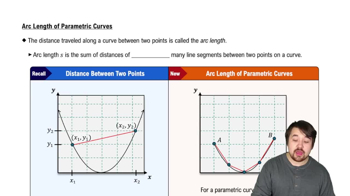
The arc length of a curve defined by x = f(y) over an interval [a, b] is found using the integral L = ∫ from a to b √(1 + (dx/dy)²) dy. This formula measures the length of the curve by summing infinitesimal line segments along the curve.
Recommended video:
06:29
Arc Length of Parametric Curves

Differentiation of Exponential Functions

To find dx/dy for functions involving exponentials like e^(√2 y), apply the chain rule. The derivative of e^(g(y)) is e^(g(y)) * g'(y), where g(y) is the exponent function. Accurate differentiation is essential for setting up the arc length integral.
Recommended video:
6:13
Exponential Functions

Evaluating Definite Integrals with Logarithmic Limits

The interval involves limits with logarithmic expressions, such as y from 0 to (ln 2)/√2. Understanding how to handle these limits and simplify expressions involving logarithms is important for correctly evaluating the definite integral for arc length.
Recommended video:
05:43
Definition of the Definite Integral